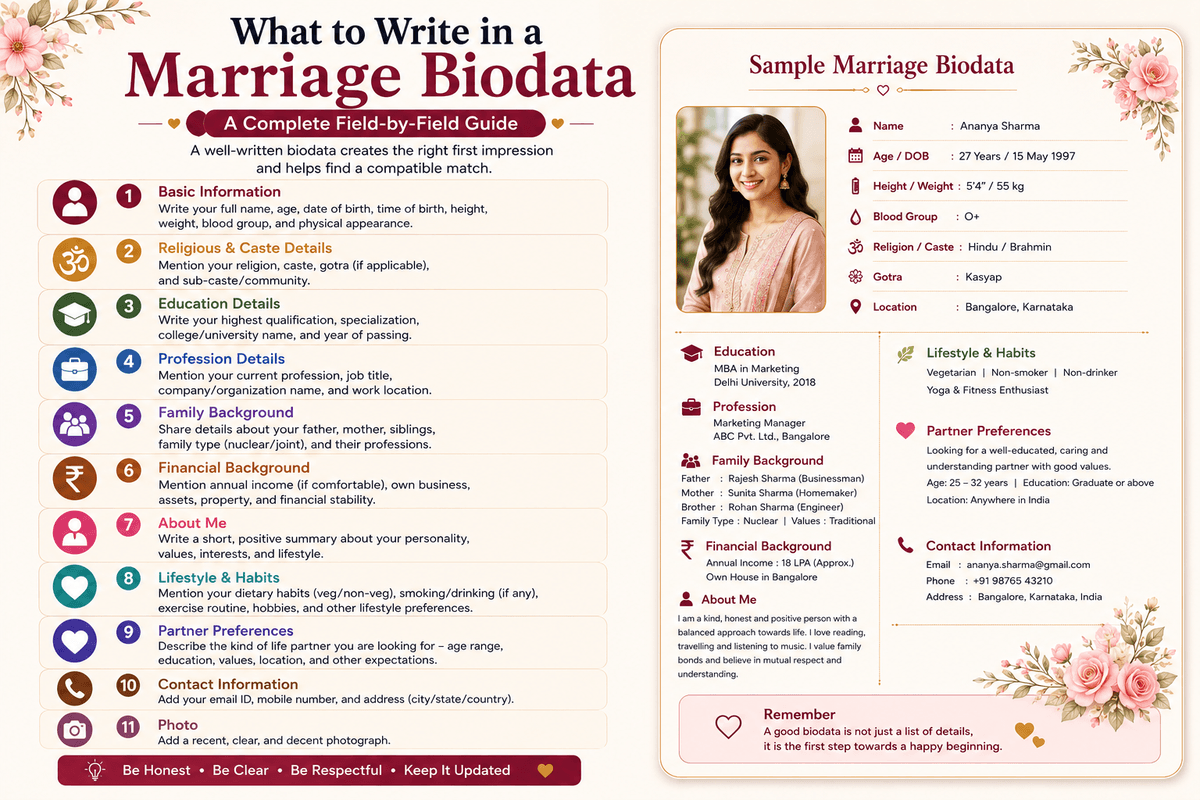
Why this is different from a how-to guide
Our how-to-make-marriage-biodata post covers the process — open the tool, enter details, choose template, download. This post covers something different: what actually goes in each field once you are sitting in front of the form, and why certain choices matter more than people realise.
Most people fill in name, date of birth, and family details without hesitation. The fields that cause genuine uncertainty are: income (exact figure or range?), Gotra (what if I don't know it?), About Me (what do I even write here?), contact number (mine or my parents'), and Manglik (what if the calculators disagree?). This guide addresses every one of these specifically.
Section 1 — Personal Details
Name: write your full name as you want it to appear — first name, middle name if used, surname. No initials unless you genuinely go by initials. Do not write your name in all-caps. Date of Birth: format DD Month YYYY, e.g. "14 March 1997," not "14/03/1997." Time of Birth: hour and minute with AM/PM, e.g. "07:25 AM" — used for horoscope calculation in Hindu families. If unknown, write "approx. morning" or "Time of birth not known." Place of Birth: city and state, e.g. "Kanpur, Uttar Pradesh" — needed for horoscope calculation and geographic placement.
Height: in feet and inches, e.g. "5 ft 7 in" — the standard Indian matrimonial format. Blood Group: A+, B+, O+, AB+, A-, B-, O-, AB- — include it, many families consider this useful. Religion and Caste: write your religion and your caste or community, e.g. "Hindu" and "Brahmin (Deshastha)." "Caste no bar" is written in Partner Preferences, not in your own Religion/Caste field.
Community-specific fields by religion
- Hindu families: Gotra (patrilineal clan lineage — ask your father if unknown), Rashi (Vedic moon sign, not Western sun sign — calculate at /horoscope-calculator), Nakshatra (birth star), Nadi (Adi, Madhya, or Antya), Gan (Deva, Manav, or Rakshasa), and Manglik status (Manglik / Non-Manglik / Partial Manglik — do not leave blank).
- Muslim families: Sect (Sunni or Shia, or sub-sect) and Biradari (Syed, Sheikh, Khan, Ansari, Pathan, etc.) — see our full guide at /muslim-biodata-for-marriage.
- Marathi families: Kul (family clan, different from gotra) and Kulswamini (family deity, e.g. Renukamata, Bhavani, Tuljabhavani) — see our full guide at /marathi-biodata-for-marriage.
- Sikh families: Gurudwara affiliation and Amritdhari status (Amritdhari / Keshdhari / Sahajdhari) — see our full guide at /sikh-biodata-for-marriage.
Section 2 — Family Details
Father's name and occupation: full name, then specific occupation — "Retired IAS Officer, Rajasthan Government," not just "Retired." Mother's name and occupation: full name, then occupation — "Homemaker" is the correct, respectful term. Siblings: number, gender, marital status, brief occupation — "One elder brother, married, software engineer in Bengaluru." If a sibling is divorced, you are not obligated to mention it in a first-introduction biodata.
Family type: joint or nuclear — if the answer is nuanced ("nuclear household but closely connected, parents live in the same building"), write that rather than forcing it into one label. Native place: the ancestral village, town, or district, even if the family has been in a city for generations — this places you in the social and community geography families use to map connections.
Section 3 — Education and Career
Education: most recent or highest qualification first — Degree, Subject, Institution, Year. "B.Tech, Computer Science — IIT Delhi (2018)." Include the institution name. Current employer and designation: company name and your actual official job title — not inflated, not vague. "Software Engineer, Amazon India — Bengaluru." If self-employed or in a family business, state that clearly.
Income: a range, always. "8–10 LPA," not "₹9,43,000." The range signals confidence and creates less friction than a number that can be cross-checked to an exact figure. If very early career, write "currently at entry level, details available on request." For NRI candidates: state foreign currency first, INR equivalent second — "CA$88,000–100,000 per year (approx. ₹54–62 LPA)."
Section 4 — About Me
3–5 sentences, maximum 100 words: one specific fact about yourself, one genuine hobby, one thing about your family relationship, and one honest sentence about what you are looking for. The full method is in our dedicated guide at /blog/how-to-write-about-me-in-marriage-biodata, and 15 examples by community, profession, and life situation are at /about-me-for-marriage-biodata.
Section 5 — Partner Preferences
2–4 sentences — an invitation, not a checklist. Cover general education and career preference, community or religion preference if relevant, location flexibility, and one sentence on values. Avoid writing physical specifications in writing, and avoid starting with requirements — lead with what you genuinely value. The full guide with 8 community-specific examples is at /blog/marriage-biodata-partner-preferences-what-to-write.
Section 6 — Contact
Contact person and number: your parent's mobile number — typically your father's. This signals that your family is actively involved, which other families find reassuring. WhatsApp: state explicitly whether the contact number is on WhatsApp, since nearly all biodata sharing in India happens through WhatsApp. Email: optional but useful for NRI matches. Address: city and state only — "Lucknow, Uttar Pradesh" — not the full street address at first introduction.
Ready to create your own biodata? Start with our free builder or browse premium templates.