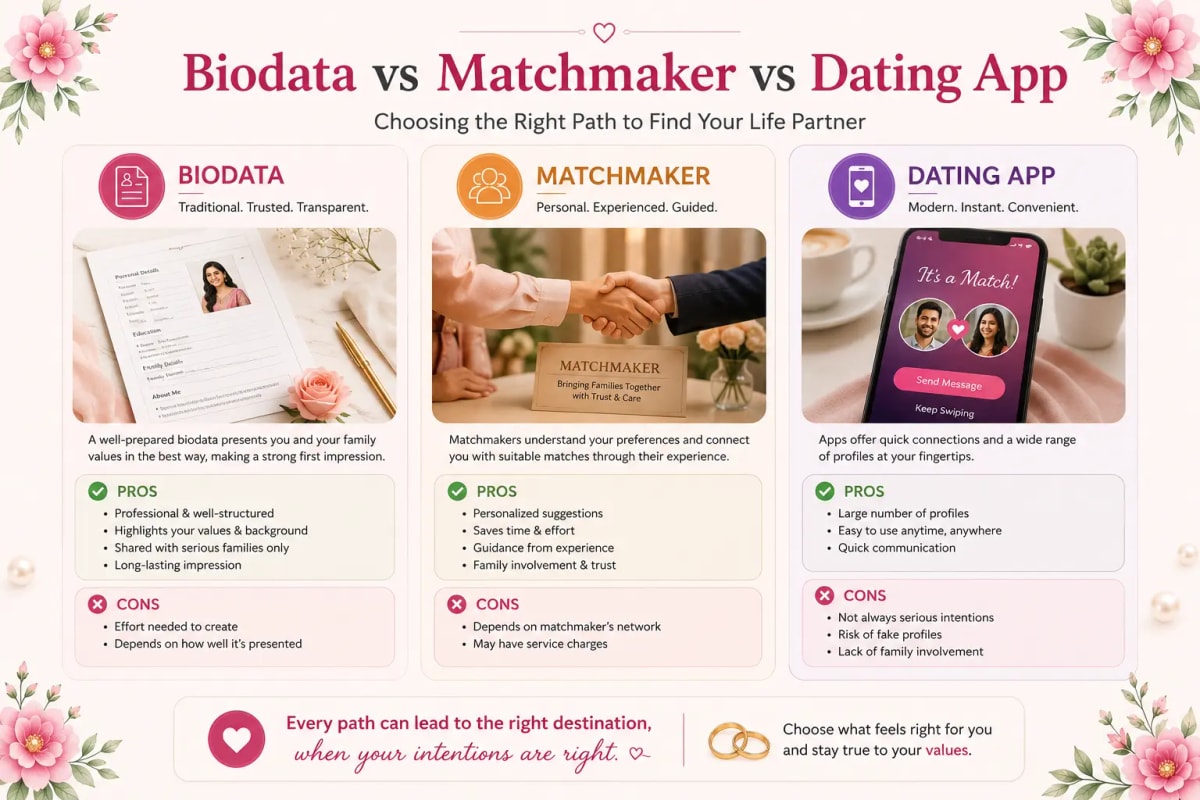
The question people are actually asking
A common reaction, especially from people more familiar with dating apps than with arranged marriage traditions, goes something like this: a matchmaker essentially does what a dating app's matching algorithm does — review profiles and suggest compatible people — except manually, slower, and probably more expensively. So why does this older system still exist at all?
It's a fair question, and the honest answer isn't that arranged marriage is simply behind the times. It's that a matchmaker working from biodatas and a dating app's algorithm are optimizing for genuinely different things, using genuinely different information.
What each one is actually built to do
Dating apps (Tinder, Hinge, Bumble, and similar)
Built for individual discovery and direct messaging based primarily on photos, a short bio, and a handful of preference filters (age, distance, sometimes religion). What they capture well: physical attraction signals, quick compatibility on stated interests, immediate two-way communication without family involvement. What they don't capture: family background, community and caste context where that matters to the people involved, horoscope compatibility for families who value it, detailed career and life-situation information, and — critically — the family's own assessment of the match, which many arranged marriage candidates and their families genuinely want as part of the process.
Matrimonial platforms (Shaadi.com, BharatMatrimony, Jeevansathi)
Built for a middle ground — individual profiles with more structured fields than a dating app (community, education, family details) plus search and filter tools, but still primarily self-directed browsing rather than manual matchmaking. What they capture well: searchability at scale, filtering thousands of profiles by specific criteria quickly. What they don't fully replace: the direct, personal biodata exchange that happens through family and community networks, which many families still prefer as the actual decision-making document even when discovery happened through a platform.
Traditional matchmaker (professional or family-facilitated)
Built for manual, relationship-based introductions — a matchmaker who knows both families, or who has built a reputation and network within a specific community, uses that knowledge to suggest matches they believe are genuinely compatible, not just algorithmically similar. What this captures well: nuance that's hard to encode in searchable fields — family reputation, unstated compatibility factors, trust built through the matchmaker's own community standing. The tradeoff: genuinely slower and lower-volume than an algorithm. This is real, and it's the fair part of the original question. But lower volume with higher relevance isn't necessarily worse — it depends what you're optimizing for.
The biodata itself
Built for being the shared document that makes all of the above work together. A matchmaker reviews biodatas to make introductions. A family receiving a biodata through community networks reviews it directly. Even someone discovered through a matrimonial platform typically has their detailed biodata as the actual document shared once initial interest is confirmed. The biodata is not competing with dating apps or matrimonial platforms — it's the underlying document format that supports the parts of the process none of the app-based tools fully replace.
Why family involvement changes what "efficient" means
The core of the original question — matchmaker seems slower and less efficient than an app — assumes efficiency means speed and volume. For many candidates and families using the biodata-and-matchmaker process, efficiency actually means something different: fewer, more relevant introductions, vetted by people who understand the specific compatibility factors that matter to that family, rather than a larger volume of matches that then need to be manually filtered by the individuals themselves.
Neither approach is objectively correct — it depends genuinely on what a person and their family are optimizing for. Someone who wants to browse independently and make their own fast judgments based on photos and short bios is well served by a dating app. Someone whose family plays a real role in the decision, and for whom community, family background, and — for many — horoscope compatibility are genuinely important factors, is better served by the biodata-and-matchmaker (or biodata-and-family-network) approach, because that's the only one of the three that's actually built to capture and act on that information.
The realistic modern approach — most people use more than one
In practice, most serious candidates today aren't choosing exclusively between these three approaches — they're using a combination: a matrimonial platform profile for broad discoverability, a well-designed biodata PDF as the actual document shared once there's mutual interest or circulated through family and community WhatsApp networks independently of any platform, and sometimes a family matchmaker or bureau running in parallel, especially for candidates whose families want a trusted intermediary's judgment alongside their own search.
The biodata is the one constant across all of these paths — regardless of how a family or candidate combines platforms, matchmakers, and community networks, the biodata is almost always the document that actually gets exchanged and reviewed once a specific introduction is being considered seriously.
Ready to create your own biodata? Start with our free builder or browse premium templates.