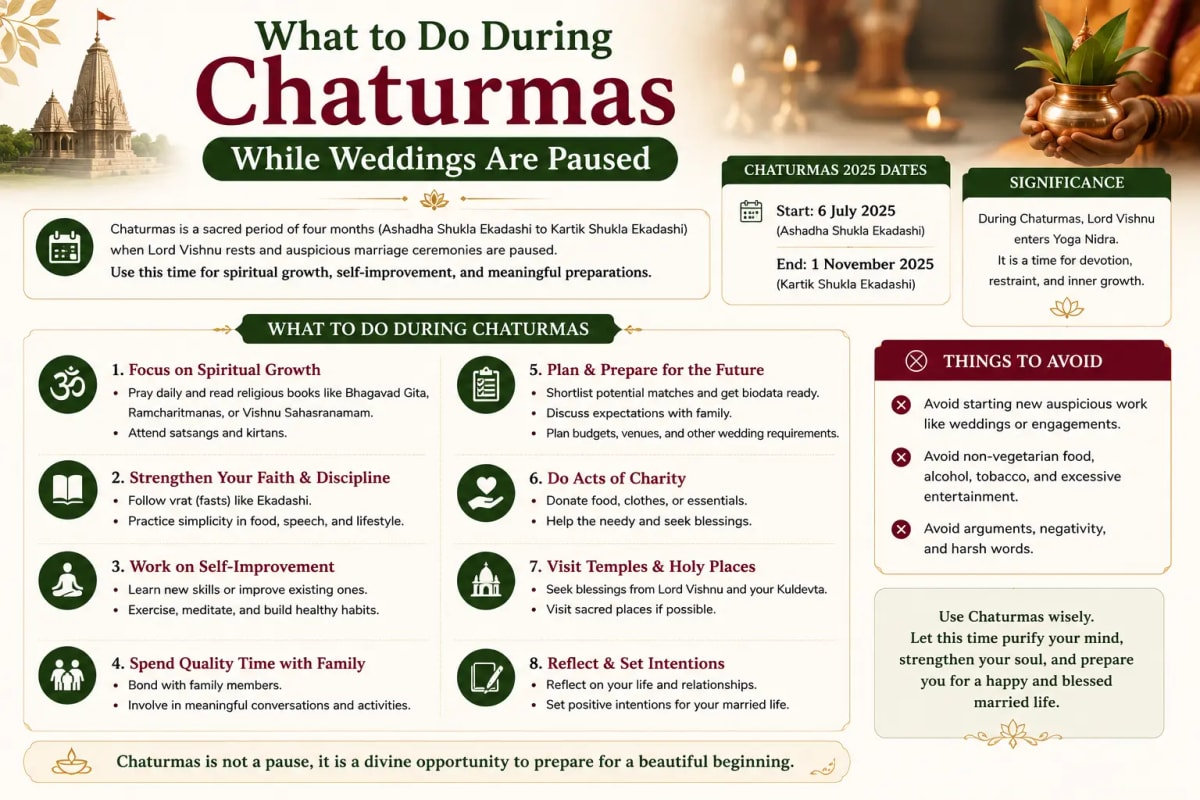
Chaturmas is a pause on weddings, not on preparation
There's a common misunderstanding that Chaturmas means the entire matrimonial process stops for four months. It doesn't. What stops is specifically the wedding ceremony — no auspicious wedding dates fall within this window in most Hindu traditions, since the period is considered spiritually unsuitable for the ceremony itself.
Everything that happens before the ceremony — and there's a lot that happens before the ceremony — can continue completely normally. This distinction matters because a lot of families treat Chaturmas as a reason to pause everything, including biodata creation and initial family conversations, when there's no actual reason to do that.
The families who understand this distinction use Chaturmas productively. The families who don't end up starting from scratch in November alongside everyone else, competing for attention in a much busier window. See our complete guide to what happens right after Chaturmas ends — /blog/devuthani-ekadashi-2026-biodata-guide
What to actually do during this window — a practical list
Finalize your biodata content. If you've been meaning to update your photo, rewrite a generic About Me section, or add missing details — this is genuinely the ideal window. There's no pressure of an imminent season deadline, which means you can take the time to get it right rather than rushing something out. See our complete field-by-field guide — /blog/what-to-write-in-biodata-for-marriage
Verify your horoscope fields. If your Rashi, Nakshatra, or Manglik status has never been formally calculated — or if you're relying on an old family record you're not fully confident in — use this quieter period to get it checked properly at /horoscope-calculator. Getting this right now means you're not scrambling to verify it later when a specific match is already progressing.
Have the honest family conversation about partner preferences. Before your biodata starts circulating widely, this is the right time for the family conversation about what actually matters — caste preferences (or the lack of them), location flexibility, career expectations. Sorting this out now, calmly, prevents mismatched expectations from surfacing awkwardly later when an actual proposal is on the table. See our guide — /blog/marriage-biodata-partner-preferences-what-to-write
Continue conversations already in progress. If you're already talking to one or more families, there's no reason those conversations need to pause just because a wedding date can't be booked yet. Meetings, phone calls, and getting-to-know-each-other conversations can all continue — what can't happen is locking in the actual ceremony date.
Research templates and formats. If you haven't created your biodata yet, this is a good time to browse options without time pressure at /templates, and to read up on community-specific format requirements if you're unsure what fields your family expects.
Can we do engagement in Chaturmas? Yes. Many families do formalize an engagement during Chaturmas even though the wedding itself waits — the restriction is specifically on the wedding ceremony, not on any other formal step in the process.
Regional and community variation during Chaturmas
The Chaturmas restriction applies specifically within Hindu tradition and its observance intensity varies somewhat by region and family — some families treat it strictly, others less so. Muslim, Sikh, Christian, and Jain families are not bound by this calendar at all (though Jain families have their own separate pause during Paryushan, which falls within this same general window — see our Jain guide — /jain-biodata-for-marriage).
Frequently asked questions
Why are Hindu weddings paused during Chaturmas? Chaturmas is the roughly four-month period (typically July to October/November) during which Lord Vishnu is traditionally considered to be in cosmic sleep (Yoga Nidra). Since Vishnu's blessing is considered essential for an auspicious marriage, no wedding ceremonies are performed during this period in most Hindu traditions. The season reopens with Devuthani Ekadashi, which marks Vishnu's symbolic awakening.
Can biodata exchange and family meetings still happen during Chaturmas? Yes, completely. Only the wedding ceremony itself is paused — biodata creation, circulation, family conversations, horoscope matching, and even engagement discussions can all continue during Chaturmas. Many families specifically use this quieter period to make progress on the earlier stages of the process, so they're ready to move quickly once the season reopens.
Ready to create your own biodata? Start with our free builder or browse premium templates.