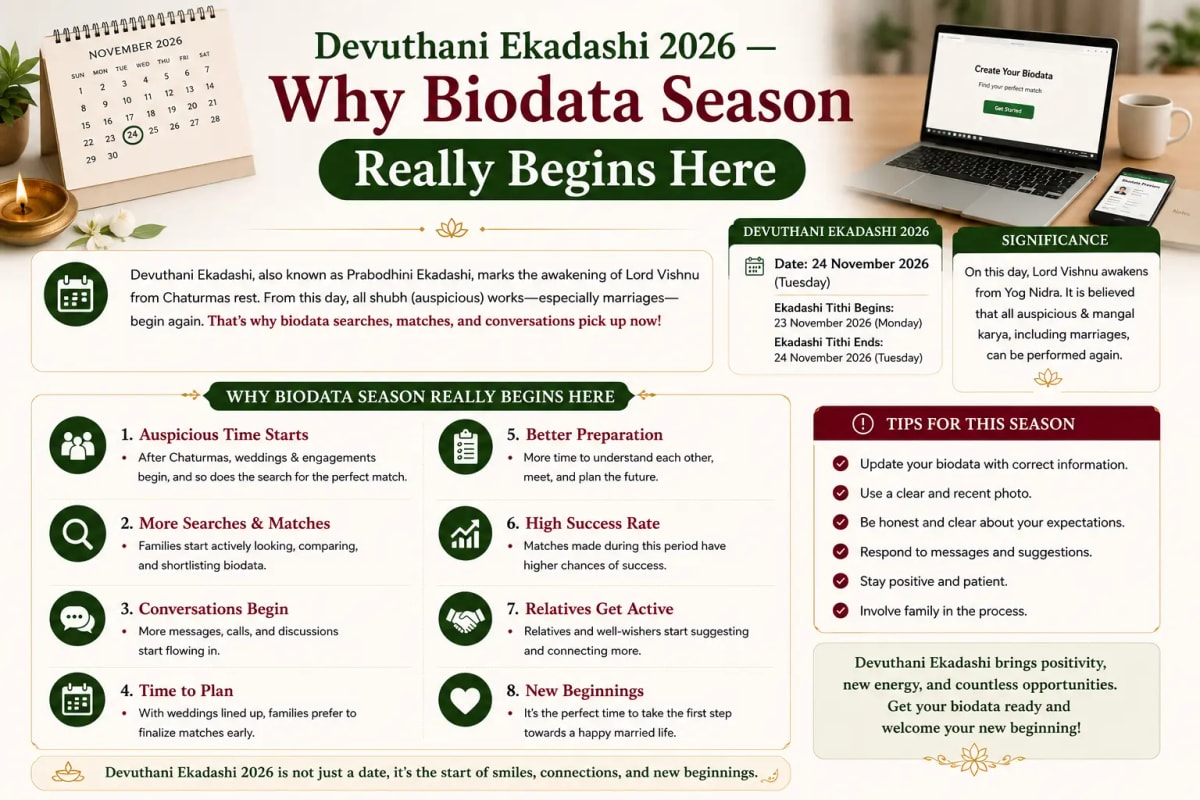
Why this one date matters more than it seems
Most people who search for Devuthani Ekadashi are looking for the date itself, or for information about the Tulsi Vivah ritual. Fewer people realize what actually happens to the matrimonial process around this date — and it's a genuinely useful thing to understand if you're in the middle of a biodata search.
For roughly four months before this date — the Chaturmas period — a significant portion of Hindu families across India pause active wedding planning almost entirely. Not because nothing else happens (biodatas still circulate, families still have conversations), but because there's an unspoken understanding that a wedding date won't actually be booked during this window, so the urgency around finalizing anything drops.
Then Devuthani Ekadashi arrives, and it's like a starting gun. Families who were "in progress" but not rushing suddenly have a reason to move — venues become bookable on auspicious dates, purohits start confirming muhurta dates, and the whole system that had been idling starts moving at once.
What actually changes in the weeks around this date
Biodata volume goes up sharply. Families who paused their active biodata review during Chaturmas — not stopping entirely, but slowing down — pick the pace back up. If you're on the sending side, this means more competition for attention in any given family's inbox during this specific window. If you're on the receiving side, expect a noticeably fuller WhatsApp group than you saw in September.
Venue bookings accelerate. Families targeting a wedding in the first open window (November through mid-December, before Kharmas) need to move quickly, since good dates and good venues get locked in fast once the season opens. This urgency trickles back into the biodata process — families are more decisive, faster to respond, because they're working against a real calendar constraint.
Purohits get busier. Horoscope matching requests pick up sharply, since this is when families with a shortlist actually push forward on Kundali Milan for the candidates they're seriously considering.
Community gatherings increase. Many communities have festivals and family gatherings in the weeks around this date — occasions where extended family naturally discusses ongoing searches, sometimes leading to informal introductions that happen outside any formal biodata exchange at all.
How to actually use this timing to your advantage
If your biodata isn't ready yet: Don't wait until after Devuthani Ekadashi to start. The two to three weeks before the date are genuinely a good window to have your biodata finalized and already known within your family's community network, so that when the broader surge happens, you're already positioned rather than starting the process from zero alongside everyone else.
If your biodata has been sitting unused since before Chaturmas: This is a natural moment to review and refresh it. Check your photo is still recent, your About Me section is specific rather than generic (see our guide on this — /blog/how-to-write-about-me-in-marriage-biodata), and your horoscope fields are accurate if you haven't verified them recently — /horoscope-calculator
If you're targeting a specific early-season wedding date: The window between Devuthani Ekadashi and Kharmas (mid-December) is relatively short — roughly six weeks. If you're hoping to be married within this window, your biodata circulation and initial family conversations should already be well underway before the date arrives, not starting on the date itself.
This is a Hindu-specific date — what about other communities
Devuthani Ekadashi and the Chaturmas pause are specifically part of Hindu religious tradition. Muslim, Sikh, and Christian families are not bound by this calendar, though many still experience a practical uptick in activity during this period simply because of shared factors — better weather, venue availability, and the general sense that "wedding season" is starting that permeates Indian social life broadly regardless of individual family religious practice. See our community-specific timing notes in the complete checklist — /wedding-season-2026-biodata-checklist
Frequently asked questions
What is Devuthani Ekadashi and why does it matter for marriage biodatas? Devuthani Ekadashi (also called Prabodhini Ekadashi or Tulsi Vivah) marks the end of Chaturmas — the four-month period when Lord Vishnu is traditionally considered to be in cosmic sleep and Hindu weddings are paused. It falls in late October or early November. From this date, the wedding season formally reopens, and it is genuinely one of the busiest windows of the year for biodata circulation, since families who held off during Chaturmas resume their search all at once.
Do weddings actually happen on Devuthani Ekadashi itself? Yes, in significant numbers. Devuthani Ekadashi is itself considered an auspicious date for weddings in many traditions, not just the date that reopens the broader season — so alongside the general uptick in biodata activity, many families specifically target the date itself or the days immediately following it for the wedding ceremony.
Ready to create your own biodata? Start with our free builder or browse premium templates.