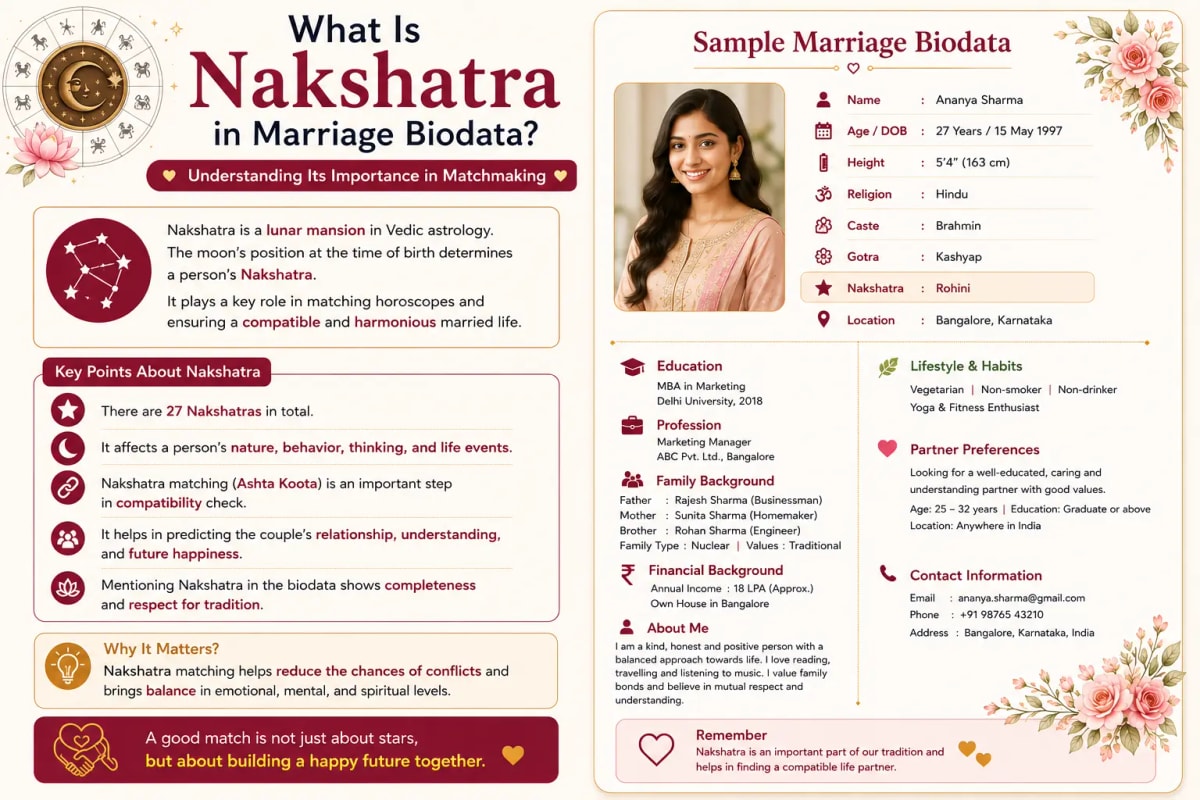
Nakshatra vs Rashi — why Nakshatra is more specific
If you have read our post on Rashi (see /blog/what-is-rashi-in-marriage-biodata), you know that Rashi is your Vedic moon sign — one of 12 signs, the Sun takes 30 days to cross, the Moon takes 2.25 days. Nakshatra is finer than Rashi. Much finer. The 360-degree zodiac is divided into 12 Rashis of 30 degrees each. The same zodiac is also divided into 27 Nakshatras of 13°20' each. Every Rashi contains exactly 2.25 Nakshatras within it.
The Moon takes about 2.25 days to cross a Rashi — and roughly 24–27 hours to cross a Nakshatra. This means two people born on the same date but at different times of day can share the same Rashi yet have different Nakshatras. For example, someone born on 14 March 1997 at 2:00 AM in Kanpur might be in Nakshatra Anuradha (Vrishchika Rashi), while someone born the same date at 4:00 PM might be in Nakshatra Jyeshtha — also Vrishchika Rashi, same sign, different birth star. Both are Vrishchika Rashi, but their Nakshatras are different, their Nadis may be different, and their Gun Milan scores with the same third person will be different — sometimes significantly. This is why astrologers say Nakshatra is more important than Rashi for marriage matching, and why birth time matters more for Nakshatra than for anything else in the horoscope section.
How Nakshatra is used in Hindu marriage matching
Nakshatra is the foundation of the Ashta Koota (8-factor Gun Milan) system. Four of the eight factors are directly determined by Nakshatra.
- Tara Koota — 3 points. Calculated by counting from the girl's Nakshatra to the boy's and dividing by 9. An odd result (Janma, Sampat, Kshema, Sadhaka, Mitra, Ati Mitra) is auspicious and adds 3 points; an even result (Vipat, Pratyari, Vadha) is inauspicious and costs points.
- Yoni Koota — 4 points. Each Nakshatra belongs to one of 14 Yoni (animal symbols) representing sexual and temperamental compatibility. Same Yoni is ideal (4 points); enemy Yonis score 0.
- Gana Koota — 6 points. Each Nakshatra belongs to one of three Ganas — Deva (divine), Manav (human), Rakshasa (demon) — which determines personality and temperamental compatibility. Same Gana pairs score highest.
- Nadi Koota — 8 points, the highest weight. Each Nakshatra belongs to one of three Nadis — Adi, Madhya, or Antya. Both partners must have DIFFERENT Nadis for the full 8 points. Same Nadi is Nadi Dosha, which scores 0 for this factor and is a strong traditional concern.
Together these four factors account for 21 of the 36 total Gun Milan points — more than half — all of them determined by Nakshatra alone. Since Nadi carries the most weight of all eight factors, this makes Nakshatra the single most important detail in the biodata for horoscope-matching families.
All 27 Nakshatras — complete reference table
| # | Sanskrit | Tamil | Rashi | Nadi | Gana |
|---|---|---|---|---|---|
| 1 | Ashwini | Aswini | Mesha (Aries) | Adi | Deva |
| 2 | Bharani | Bharani | Mesha | Antya | Manav |
| 3 | Krittika | Krithigai | Mesha / Vrishaba | Madhya | Rakshasa |
| 4 | Rohini | Rohini | Vrishaba (Taurus) | Antya | Manav |
| 5 | Mrigashira | Mirugaseerisham | Vrishaba / Mithuna | Madhya | Deva |
| 6 | Ardra | Thiruvadirai | Mithuna (Gemini) | Adi | Manav |
| 7 | Punarvasu | Punarpoosam | Mithuna / Karka | Adi | Deva |
| 8 | Pushya | Poosam | Karka (Cancer) | Madhya | Deva |
| 9 | Ashlesha | Ayilyam | Karka | Antya | Rakshasa |
| 10 | Magha | Magam | Simha (Leo) | Adi | Rakshasa |
| 11 | Purva Phalguni | Pooram | Simha | Madhya | Manav |
| 12 | Uttara Phalguni | Uthiram | Simha / Kanya | Antya | Manav |
| 13 | Hasta | Hastam | Kanya (Virgo) | Adi | Deva |
| 14 | Chitra | Chithirai | Kanya / Tula | Madhya | Rakshasa |
| 15 | Swati | Swathi | Tula (Libra) | Antya | Deva |
| 16 | Vishakha | Visagam | Tula / Vrishchika | Adi | Rakshasa |
| 17 | Anuradha | Anusham | Vrishchika (Scorpio) | Madhya | Deva |
| 18 | Jyeshtha | Kettai | Vrishchika | Antya | Rakshasa |
| 19 | Moola | Moolam | Dhanu (Sagittarius) | Antya | Rakshasa |
| 20 | Purva Ashadha | Pooradam | Dhanu | Madhya | Manav |
| 21 | Uttara Ashadha | Uthiradam | Dhanu / Makara | Adi | Manav |
| 22 | Shravana | Thiruvonam | Makara (Capricorn) | Antya | Deva |
| 23 | Dhanishtha | Avittam | Makara / Kumbha | Madhya | Rakshasa |
| 24 | Shatabhisha | Sadayam | Kumbha (Aquarius) | Adi | Rakshasa |
| 25 | Purva Bhadrapada | Poorattathi | Kumbha / Meena | Madhya | Manav |
| 26 | Uttara Bhadrapada | Uthirattathi | Meena (Pisces) | Antya | Manav |
| 27 | Revati | Revathi | Meena | Adi | Deva |
Nadi groupings for quick reference — Adi Nadi: Ashwini, Ardra, Punarvasu, Uttara Phalguni, Hasta, Jyeshtha, Moola, Shatabhisha, Purva Bhadrapada. Madhya Nadi: Bharani, Mrigashira, Pushya, Purva Phalguni, Chitra, Anuradha, Purva Ashadha, Dhanishtha, Uttara Bhadrapada. Antya Nadi: Krittika, Rohini, Ashlesha, Magha, Swati, Vishakha, Uttara Ashadha, Shravana, Revati.
Pada — the quarter within the Nakshatra
Each Nakshatra is divided into 4 Padas (quarters), each spanning 3°20'. The Pada is written after the Nakshatra name in the biodata: "Anuradha, Pada 3" or "Rohini, Pada 2." Pada is used mainly for baby name selection (Naamkaran) — each Pada corresponds to specific starting syllables (Akshar) considered auspicious for the child's name. In a marriage biodata, write the Pada when you know it, as it gives the purohit the most precise horoscope identification; if unknown, the Nakshatra name alone is sufficient for most purposes.
Is Pada used for marriage matching? Not directly — the eight Gun Milan factors are calculated from Nakshatra, not from Pada. Some regional traditions, particularly in South India, use Pada for additional fine-tuning of compatibility. Your family purohit will advise whether Pada is required.
What to write in the biodata field
- Standard format: Nakshatra: Anuradha
- With Pada (more specific): Nakshatra: Anuradha, Pada 3
- Tamil biodata format: Natchathiram: Anusham (Pada 3)
- Telugu biodata: usually the Sanskrit name or Telugu equivalent — "Anuradha" is used widely.
What NOT to write: do not write a Western constellation name — Scorpius, Orion — these are not the same as Vedic Nakshatras even where the names overlap. Do not write your Rashi in the Nakshatra field either — they are different things and a purohit will immediately notice the error.
What if my Nakshatra is one of the "difficult" ones?
Certain Nakshatras have a reputation in popular astrology that causes unnecessary anxiety — Moola, Ashlesha, and Jyeshtha are sometimes called "difficult" or "inauspicious," particularly for the spouse's family. A few things put this in context: these labels come from specific traditional texts, not from universal Vedic astrology, and different astrological traditions and different Jyotishis assess them differently. Moola (the 19th Nakshatra, in Dhanu) is specifically flagged in some texts only for Pada 1 — the other three Padas are not considered inauspicious, and many Jyotishis perform a Moola Shanti ceremony at birth and consider the matter resolved. Jyeshtha (the 18th Nakshatra, in Vrishchika) concerns in some texts relate to the spouse's elder sibling — a tradition-specific concern many modern families and Jyotishis do not apply. Ashlesha (the 9th Nakshatra, in Karka) concerns relate to various family members depending on the specific Pada, again applied variably.
Why birth time matters more for Nakshatra than for Rashi
From our Rashi post (see /blog/what-is-rashi-in-marriage-biodata): Rashi is usually correct even with an approximate birth time, because the Moon spends 2.25 days (54 hours) in a single Rashi. Nakshatra is different — the Moon spends only 24–27 hours in each Nakshatra, roughly one day. If your birth time is unknown and you use 12:00 noon as the default, the calculated Nakshatra is correct for that date's midpoint, but if your birth actually happened near a Nakshatra transition, your actual Nakshatra could differ from the calculated one. A Nakshatra transition happens roughly once per day, so if your birth date is near one, the noon-default calculation may be wrong.
- Try to get a birth time — ask parents, look for hospital records, or check old horoscope charts the family had made.
- Even "morning around 8 AM" narrows the window significantly.
- If Nakshatra matters for your family's matching process, visit a traditional Jyotishi who can calculate it precisely — or identify it through Prashna (horary astrology) if the exact time is truly unknown.
- In the biodata: if you genuinely don't know birth time, write "Nakshatra: [calculated name] (birth time approximate — verify if required)." This is honest and tells the receiving family the precision level.
Ready to create your own biodata? Start with our free builder or browse premium templates.