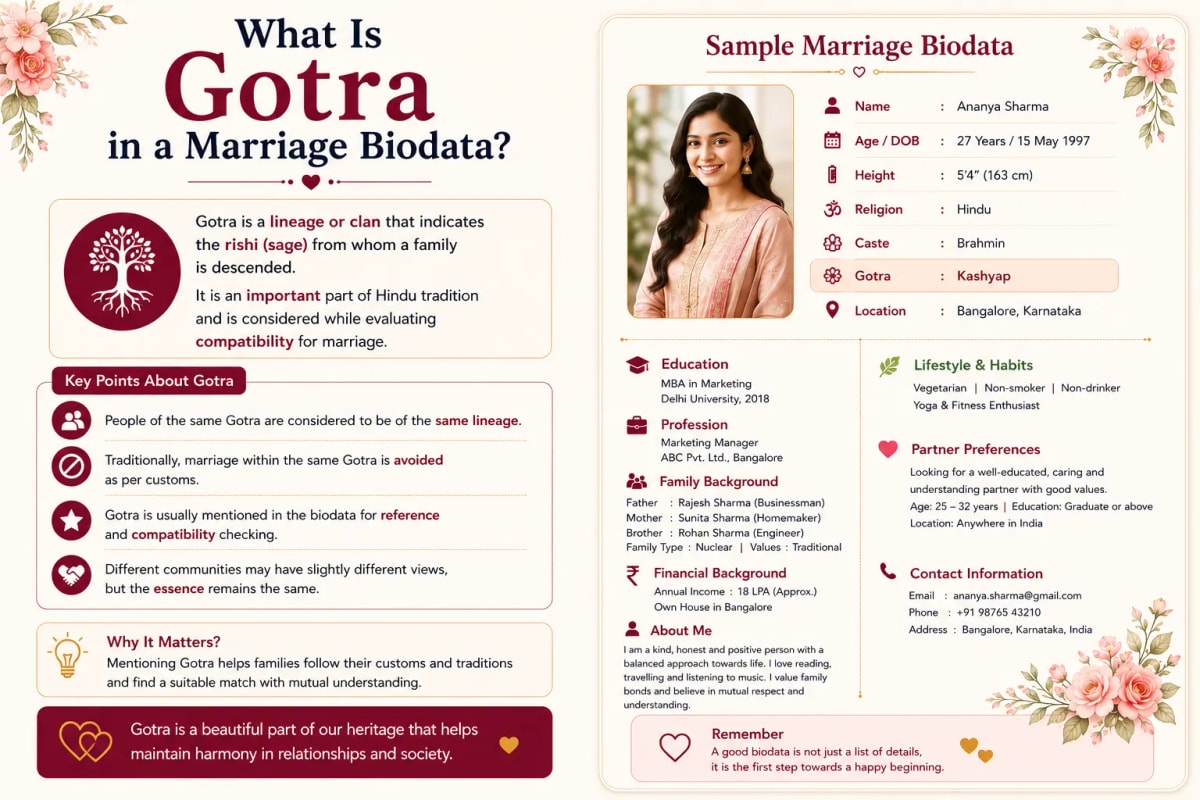
What Gotra actually means — without the complicated version
The word "Gotra" comes from Sanskrit — literally "cow shelter" or "lineage enclosure" — but its practical meaning in matrimonial culture is simpler: it is your clan name, inherited through your father. Every Hindu family traces its Gotra to one of the ancient rishis (sages) who founded different lineages in Vedic tradition. The most commonly referenced founding sages are the Saptarishis — seven great rishis whose lineages form the root of most Hindu Gotra systems. Over thousands of years, these lineages branched into hundreds of distinct Gotras across different communities and regions.
The rule that makes Gotra matrimonially relevant is called Gotra exogamy: you must marry outside your Gotra. The logic is that people of the same Gotra share a common male ancestor — they are considered to be of the same "family" in that ancestral sense, even if separated by forty generations and living in different states. Marrying within this clan is treated as a form of consanguinity, which traditional Hindu law prohibits. This is why the Gotra field appears in marriage biodatas. It is not decoration or superstition — it is a practical check that both families run before proceeding with a match.
How Gotra is passed down
Your Gotra equals your father's Gotra, which equals your paternal grandfather's Gotra, and so on. For men: your Gotra is the same as your father's — it does not change when you marry, move cities, or change your surname. For women: you are born with your father's Gotra, and when you marry, you adopt your husband's Gotra — the traditional convention in most Hindu communities. Children: a child's Gotra is always the father's Gotra, regardless of the mother's original Gotra.
This is also why surnames and Gotras do not correspond. A family may have used "Sharma" as a surname for generations while tracing their Gotra to Bharadwaj — and another Sharma family in the same colony may have a completely different Gotra (Kashyap, Atri, Vashishth). The surname "Sharma" historically indicated a Brahmin occupation or status, not a single bloodline.
Why families check Gotra before everything else
In many traditional Hindu families — particularly Brahmin families across North and South India, and Rajput families in Rajasthan and UP — the Gotra check happens before the education or career section of the biodata is even opened. The reason is sequence: if the Gotra matches in both biodatas, the match cannot proceed regardless of how compatible everything else looks. Checking Gotra first prevents families from investing emotional and social capital in a match that will ultimately have to be rejected. This is not unique to conservative or rural families — many highly educated, urban, professional Hindu families check Gotra with the same rigour their grandparents did. It is one of the rare matrimonial practices that has not softened significantly with urbanisation.
The most common Gotras — by community
- Brahmin communities (pan-India): Kashyap, Bharadwaj, Atri, Vishwamitra, Vashishth, Sandilya, Garg, Parashara, Kaushik, Kaundinya, Angirasa, Agastya, Jamadagni, Gautama. Eight of these — Kashyap, Bharadwaj, Atri, Vishwamitra, Vashishth, Gautama, Jamadagni, and Agastya — are often called the "Ashta Gotras" from which many other Brahmin Gotras are derived.
- Aggarwal / Vaishya / Baniya communities: Garg, Goyal, Bansal, Mittal, Singhal, Tayal, Mangal, Jindal, and others tied to 18 sub-groups — same-Gotra marriage is avoided here too.
- Rajput communities (Rajasthan, UP, MP): tied to Vansh (Suryavanshi, Chandravanshi, Agnivanshi) and then to clans — Chauhan, Rathore, Sisodia, Kachwaha, Panwar, Bhati, Tomar, Solanki.
- Kayastha communities: Saksena, Srivastava, Mathur, Nigam, Kulshreshtha, Karna, Asthana, Bhatnagar, Gaur.
- Marathi Brahmin communities use Kul (family deity) and Gotra together — common Gotras: Kashyap, Bharadwaj, Vashishth, Atri, Kaundinya. See our Marathi biodata guide at /marathi-biodata-for-marriage.
- South Indian Brahmin (Tamil Iyer/Iyengar): Kashyapa, Bharadvaja, Harita, Srivatsa, Mudgala, Koundinya, Angirasa, Vashishtha, Atri, Vishvamitra.
Gotra vs Pravara — what the purohit will ask
When you consult a purohit for a wedding Kundali check, they ask for both Gotra and Pravara. Gotra is the founding sage lineage, as described above. Pravara is the list of two to five ancestor sages cited during Vedic rituals that a person identifies with in their Gotra lineage — more specific than Gotra, a sublineage within it. For the biodata, you only need the Gotra name. Pravara is not a biodata field — it comes up during the formal Kundali exchange with a purohit, not in the first-introduction biodata.
What if I genuinely don't know my Gotra?
This is more common than families admit, particularly among families that migrated from villages to cities two or three generations ago. Step 1: ask your father — this should be the first and only step for 90% of people. Step 2: ask your paternal grandfather or uncle if your father is unavailable or uncertain. Step 3: check old family records — wedding invitations from two or three generations ago, or an existing horoscope chart, sometimes contain the Gotra. Step 4: contact the ancestral village or a community organisation (samaj), which may maintain records — for diaspora families, community associations abroad sometimes maintain them too.
If Gotra is genuinely unknown after all of this, write "Gotra not known." This is the honest answer. Most families who receive this will ask you to look it up before they proceed, which is reasonable. What they will not appreciate is a blank field, a guess, or your surname written in the Gotra column.
Common mistakes — what families actually notice
- Writing your surname in the Gotra field — the single most common error. "Sharma" is a surname, not a Gotra, and a purohit reviewing the biodata will catch this immediately.
- Writing "N/A" — this implies Gotra doesn't apply to you. For a Hindu family, it does. It reads as evasion or ignorance.
- Writing a Gotra that doesn't exist in any tradition — place names, invented terms, or guesses are noticed immediately by a purohit.
- Leaving the field blank while filling every other horoscope field — a blank Gotra next to a filled Rashi, Nakshatra, and Manglik looks selective rather than honest.
Ready to create your own biodata? Start with our free builder or browse premium templates.