The most common mistake — writing your Western sun sign as your Rashi
Every year, thousands of marriage biodatas in India are filled with the wrong Rashi. Not because the person lied — because they confused two completely different systems. Here is how it happens: a 26-year-old software engineer in Pune opens their biodata form, reaches the Rashi field, and thinks "Rashi — that's my zodiac sign." They were born on November 8. They know from Instagram and magazine horoscopes that they are a Scorpio. They write "Vrishchika" (Scorpio) — but for someone born on that date at a specific time and place, the actual Vedic Rashi might be Tula (Libra), because the Moon was in Libra at that specific time and place — not Scorpio.
When the families exchange biodatas and the purohit checks Gun Milan, an incorrect Rashi produces incorrect compatibility scores. The error surfaces, and someone has to explain why the biodata had the wrong information. The fix is simple — calculate, don't guess.
Why Rashi and Western sun sign are different — the actual explanation
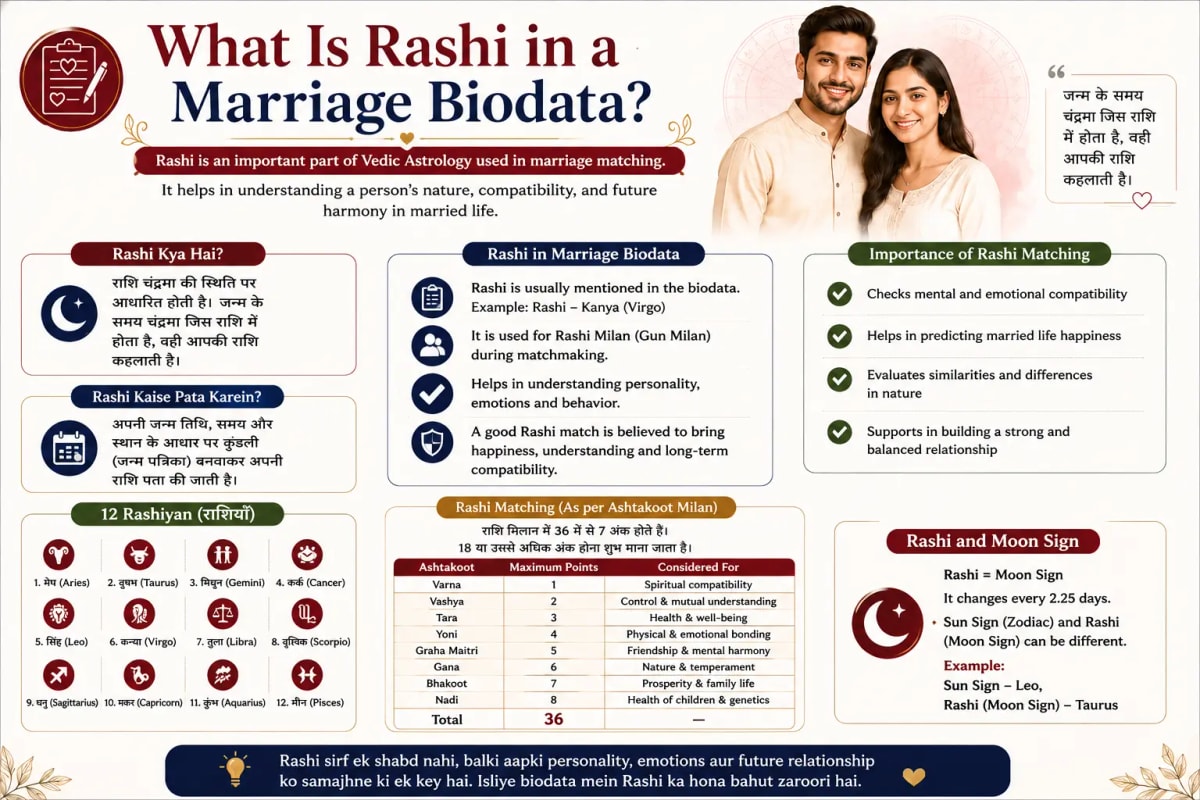
Different planets, different speeds. Your Western sun sign is determined by the Sun's position — the Sun moves through all 12 zodiac signs in one year, spending about 30 days in each. Everyone born in roughly the same month shares the same Western sun sign; it is specific to the time of year, not to you. Your Vedic Rashi is determined by the Moon's position — the Moon moves much faster, travelling through all 12 zodiac signs in about 28 days, spending only 2.25 days in each sign. Two people born on the same day but at different times of day or in different cities can have different Rashis. This is why Rashi is considered more personally meaningful in Vedic astrology — it reflects the Moon's position at your specific birth moment and location.
Different zodiac systems. Vedic astrology uses the sidereal zodiac — the positions of planets measured against the actual background of fixed stars in the sky. Western astrology uses the tropical zodiac — the positions of planets measured against the Earth's seasonal cycle. Because Earth's axis precesses over a 26,000-year cycle, the tropical and sidereal zodiacs have drifted apart by about 23–24 degrees — called the Ayanamsha. The Lahiri Ayanamsha is the standard correction factor used by Indian astrologers and government-approved ephemerides. The practical result: your Vedic Rashi is typically one or two signs "earlier" than your Western sun sign. Someone who is Scorpio in Western astrology is often Libra (Tula) or sometimes Virgo (Kanya) in Vedic. The rule: for a marriage biodata, always use the Vedic Rashi. Never use the Western sun sign. When in doubt — calculate.
The 12 Rashis — Sanskrit, English, and Tamil names
- Mesha (Aries) — Tamil: Mesham
- Vrishaba (Taurus) — Tamil: Rishabham
- Mithuna (Gemini) — Tamil: Mithunam
- Karka (Cancer) — Tamil: Katakam
- Simha (Leo) — Tamil: Simmam
- Kanya (Virgo) — Tamil: Kanni
- Tula (Libra) — Tamil: Tulam
- Vrishchika (Scorpio) — Tamil: Vrichigam
- Dhanu (Sagittarius) — Tamil: Dhanusu
- Makara (Capricorn) — Tamil: Makaram
- Kumbha (Aquarius) — Tamil: Kumbham
- Meena (Pisces) — Tamil: Meenam
What to write in the biodata: the Sanskrit name in North Indian and pan-India biodatas — Vrishchika, Mesha, Karka. Tamil biodatas use the Tamil names — Vrichigam, Mesham, Katakam.
How Rashi is used in marriage matching — the specifics
Rashi matters in Hindu marriage matching in three distinct ways. Bhakoot Koota (7 points in Gun Milan) checks the relative position of the boy's and girl's Rashis — certain positions are considered favourable, others inauspicious. The inauspicious combinations, called Bhakoot Dosha, include the 6-8 position (one person's Rashi is 6th from the other's) and the 2-12 position. These doshas reduce the score by 7 points, though like most doshas, Bhakoot Dosha has recognised cancellations — when Rashi lords are friends, or Nakshatra compatibility is strong, many Jyotishis proceed even with Bhakoot Dosha.
Tara Koota (3 points) checks Nakshatra compatibility — but Nakshatra is determined from Rashi, so an incorrect Rashi leads to an incorrect Nakshatra and an incorrect Tara score. Nadi Koota (8 points, the most important) — each Nakshatra belongs to one of three Nadis (Adi, Madhya, Antya), determined from Nakshatra, which is determined from Rashi. Again, an incorrect Rashi cascades into an incorrect Nadi score, which carries the highest weight in the entire Gun Milan system. This is why calculating Rashi correctly matters beyond the Rashi field itself — a wrong Rashi produces wrong Nakshatra, wrong Nadi, and a wrong Gun Milan score. For the full picture of how Nakshatra works and why birth time matters even more for it than for Rashi, see our guide at /blog/what-is-nakshatra-in-marriage-biodata.
What Rashi tells a family beyond horoscope matching
Some families who do not prioritise formal Gun Milan still find Rashi useful as a personality compatibility indicator. In Vedic tradition, each Rashi is associated with certain personality traits and temperaments — not as deterministic fate, but as tendencies associated with the Moon's energy in that zodiac position. Karka (Cancer) is associated with nurturing, home-orientation, and strong family attachment. Vrishchika (Scorpio) is associated with intensity, determination, and depth. Tula (Libra) is associated with balance, aesthetics, and relationship-orientation — the "marriage Rashi" in some traditions. Dhanu (Sagittarius) is associated with optimism, knowledge-seeking, and independence. Most families do not make decisions based on Rashi personality traits alone, but it provides a conversational shorthand and a cultural frame for discussing compatibility that both families understand.
Rashi in South Indian biodatas — same system, different names
South Indian biodatas (Tamil, Telugu, Kannada, Malayali) use the same 12 Rashis as North Indian biodatas — the Vedic sidereal system is consistent across India. What differs is the name used: Tamil biodatas use Tamil names while North Indian biodatas use Sanskrit names. Telugu biodatas generally use the same Sanskrit names, sometimes with Telugu transliteration. Malayalam biodatas use the Sanskrit names with Malayalam pronunciation. The underlying Rashi is the same — "Mesham" in Tamil and "Mesha" in Sanskrit are the same first Rashi, Aries. Only the script and pronunciation differ, not the content. If your biodata will be shared with South Indian families, check which naming convention they prefer — both are correct, and any family with a Jyotishi will understand both.
What to do if you don't know your Rashi
This is the most common reason people leave the Rashi field blank — they genuinely don't know it, and they're afraid of writing the wrong one. The solution takes two minutes. Go to our free horoscope calculator at /horoscope-calculator. Enter your date of birth, time of birth (if known — enter 12:00 noon if not), and place of birth. The calculator returns your Rashi instantly, using the Lahiri Ayanamsha standard, along with Nakshatra, Pada, Nadi, Gan, and Manglik status — all the fields you need for the horoscope section of your biodata. Copy each result directly into the biodata form.
If birth time is unknown, the Rashi result is usually accurate — the Moon spends 2.25 days in each sign, so the Rashi is correct for most people regardless of the exact birth time. The exception is if your birth fell right at the transition point between two Rashis — in that case, check with your family's purohit.
Ready to create your own biodata? Start with our free builder or browse premium templates.