Why this question is harder to search than it should be
Every other field-explanation question in Indian matrimonial culture — what is Gotra, what is Manglik, what is Biradari — has a straightforward factual answer that people search for without hesitation. The caste question is different. People searching "what caste should I write in biodata" are often searching quietly, sometimes on an incognito browser, because the question itself feels uncomfortable to ask openly.
This discomfort is legitimate. Caste in India carries centuries of social weight, historical injustice, and ongoing debate about its place in modern life — debates that are far bigger than a biodata form. This post does not attempt to resolve that debate. It answers the practical question: what do you actually write in this field, and how do you handle it when your own views differ from what your family expects.
The caste field is about identity, not endorsement
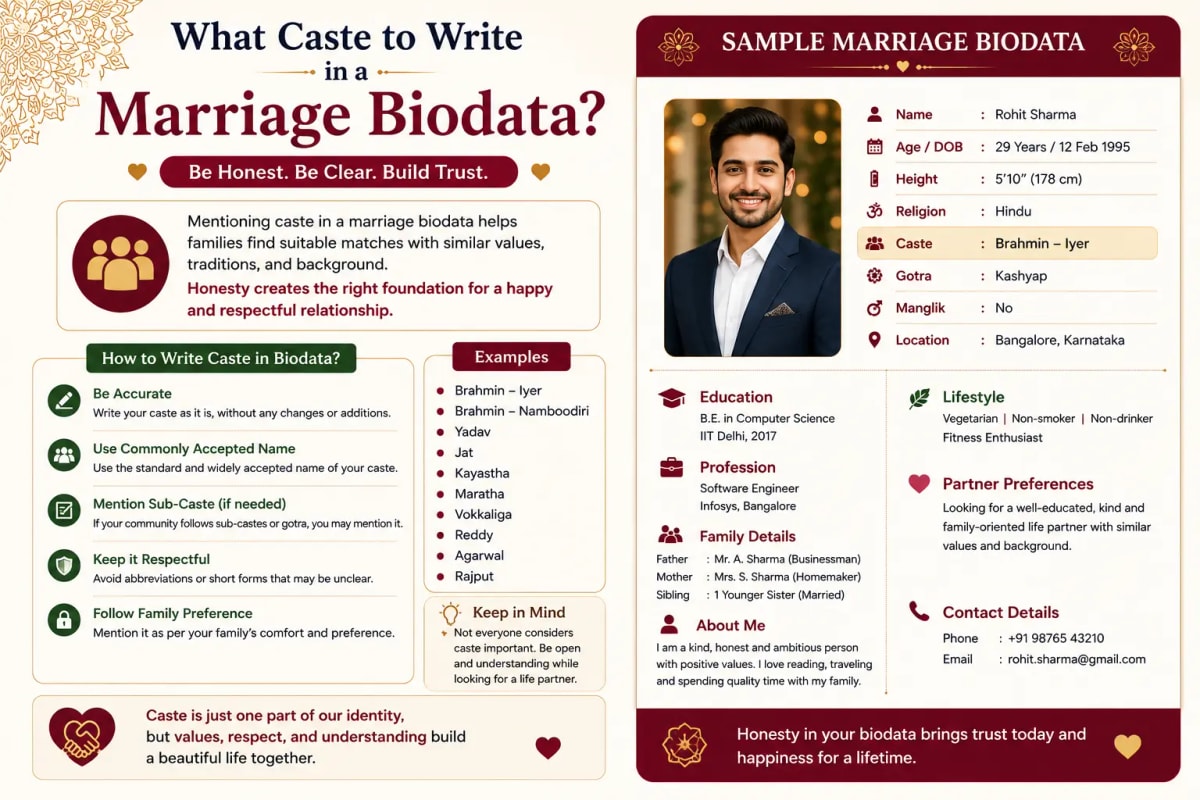
The single most useful reframe for this field: writing your caste in a biodata is not an endorsement of caste-based discrimination. It is a factual identity statement — similar to stating your religion, your mother tongue, or your state of origin.
A biodata that states "Caste: Yadav" is not making a moral claim about caste. It is telling the receiving family a fact about your community background — the same way stating "Native place: Gorakhpur, UP" is a fact, not a value judgment about Gorakhpur.
What families DO with that information — whether they treat it as a hard filter, a soft preference, or irrelevant information — is a separate matter entirely, determined by each family's own values. The biodata field itself is neutral. Refusing to fill it in doesn't remove caste from the matching process for families who care about it; it just removes information that would have let the process move faster and more honestly.
What to actually write — by situation
Situation 1 — Your family actively uses caste as a matching criterion
Write your caste honestly and specifically. If your family is Brahmin, write the sub-caste if your family typically specifies it: "Brahmin (Kanyakubj)," "Brahmin (Iyer)," "Brahmin (Deshastha)." If your family is from a community where sub-caste specificity matters for matching — many Rajput, Yadav, Kayastha, and Nair families check sub-group — include that detail. This is the straightforward case. Your family knows what they're looking for, they'll check the receiving biodata for the same information, and writing it clearly saves time for everyone.
Situation 2 — Your family is open but wants caste stated for context
Some families do not use caste as a hard filter but still want it stated — either out of habit, because relatives will ask, or because they believe some information is better shared than withheld even if it won't determine the outcome. Write your caste in the identity field. Then in partner preferences, write something like: "Caste no bar, though similar community background preferred" or simply "Caste no bar." This tells the receiving family your identity honestly while signalling genuine openness.
Situation 3 — Your family genuinely does not consider caste at all
Write your caste in the identity field if you know it (many people know their caste even if they don't personally weight it in decision-making) — and write "Caste no bar" clearly in partner preferences. If you genuinely prefer not to state your own caste identity at all, that is your choice — but understand that most traditional families receiving your biodata will still want to know, and its absence may generate a follow-up question rather than being read as intended openness.
Situation 4 — You are creating your own biodata independently and disagree with your family's caste preferences
This is increasingly common, particularly among urban, educated candidates in their late twenties managing their own search while parents remain involved in some capacity. If you are the one filling in the biodata and have full control over its content, you can write your identity honestly and set your own preferences — including "Caste no bar" — regardless of what your parents might have specified if they were creating it.
If your parents are creating the biodata and you disagree with their approach, this needs a direct conversation before the document is finalised and circulated — not a passive-aggressive edit after the fact. Many families find a workable middle ground once the conversation actually happens.
"Caste no bar" — what it actually signals, and when it doesn't mean what it says
"Caste no bar" is one of the most common phrases across Indian matrimonial platforms — and one of the most inconsistently applied.
When it's genuine: the family has no caste filter at all. Any match from any community that meets other criteria (education, values, location) will be seriously considered. These families exist in significant numbers, particularly in urban, professionally-oriented, and inter-community-marriage-accepting households.
When it's aspirational but not fully genuine: the family writes "caste no bar" because it feels progressive or because they don't want to seem narrow-minded in writing — but in practice, when an actual proposal comes from a caste significantly different from their own (especially across traditional social hierarchies), reservations surface that weren't disclosed upfront. This pattern comes up repeatedly in Reddit discussions and Quora answers from people navigating Indian arranged marriage — candidates who responded to a "caste no bar" biodata only to find the family's actual behaviour didn't match the stated openness.
- If you are writing "caste no bar" — mean it. If any caste, or category of caste, would actually cause your family to hesitate, either don't write "caste no bar," or have the honest family conversation first so the statement reflects the family's real position.
- If you are receiving a biodata that says "caste no bar" — take it at face value initially, but if the relationship progresses to a serious stage, it is reasonable to confirm the openness is genuine and specific to your situation.
Regional and community variation — this isn't uniform across India
How rigidly caste functions as a matching criterion varies significantly by region, community, and generation. Where caste-based matching remains strongest: rural and semi-urban families across North India, particularly in UP, Bihar, Haryana, and Rajasthan; South Indian Brahmin communities (Iyer, Iyengar) where sub-caste and even sub-sect (Vadama, Brahacharanam) matching is common; Marwari and trading community families where caste and business network overlap significantly.
Where caste-based matching has weakened significantly: urban professional families in metros, particularly in tech and corporate sectors; second-generation NRI families whose social circles have diversified beyond community lines; inter-caste and inter-community marriage has grown substantially in India's largest cities over the past two decades, and many urban families reflect this shift in their own matrimonial expectations.
Most of India falls somewhere between these two extremes — families that check caste but wouldn't reject a strong match purely on that basis, or families that state openness but retain some preference in practice. There is no single "correct" position — the honest position for your family is the one that reflects their actual decision-making, whatever that is.
A note on Scheduled Caste, Scheduled Tribe, and OBC categories
For candidates whose families belong to Scheduled Caste (SC), Scheduled Tribe (ST), or Other Backward Class (OBC) categories, the caste field in a biodata sometimes carries additional considerations beyond matrimonial matching alone — particularly around whether and how to state category status, given the complex history of caste-based discrimination in India.
There is no single correct approach here beyond the same underlying principle: honesty about your actual identity, stated with the same confidence and lack of apology as any other identity field in the biodata. A biodata that states "Caste: Chamar" or "Caste: SC (Jatav)" with the same straightforward formatting as any other caste entry treats the information appropriately — as identity, not as something requiring special framing or minimisation. Families navigating this consideration are encouraged to write their community identity with the same confidence they would apply to any other factual field in the biodata.
Ready to create your own biodata? Start with our free builder or browse premium templates.