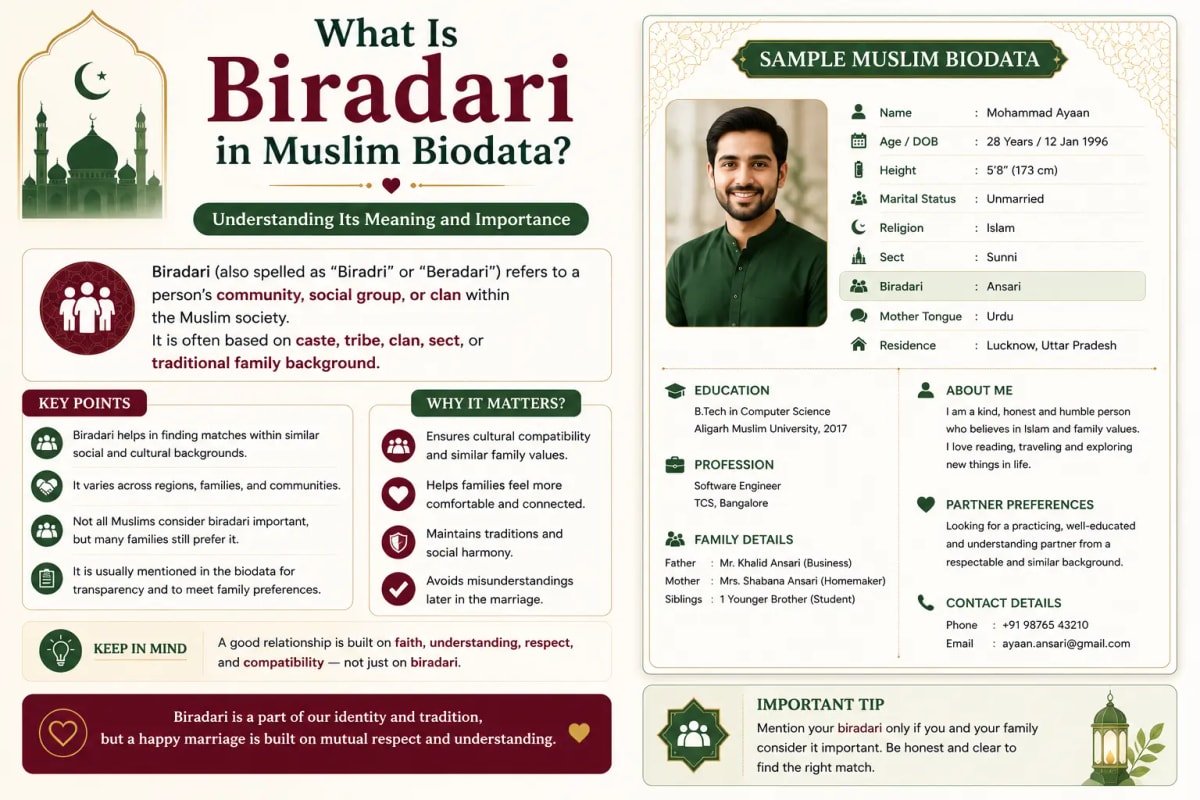
What Biradari means — the honest explanation
Biradari literally means "brotherhood" in Urdu and Farsi — from "birad" (brother) and "ari" (a suffix denoting belonging). In South Asian Muslim usage, it means the community or kinship group you belong to — a social category that combines genealogical claims, occupational history, and geographic origin. It is one of the most searched and most debated topics in Indian Muslim matrimonial culture — questions like "Is Biradari Islamic?" and "Why do Indian Muslims check Biradari for marriage?" draw hundreds of answers on Quora India, and threads on Reddit's r/Arrangedmarriage about families refusing matches across Biradari lines get dozens of comments from candidates frustrated by the practice.
The debate has two sides genuinely in tension. The Islamic position: the Quran (49:13) states that mankind was made into nations and tribes so that people may know one another, and that the most honoured in the sight of Allah is the most righteous — a verse most Islamic scholars interpret as rejecting caste and lineage-based discrimination. The social reality: despite the theological position, Biradari-based matching remains common in North Indian, Hyderabadi, Pakistani-origin, and many other South Asian Muslim matrimonial contexts — families check it, value it, and in some communities maintain strict within-Biradari endogamy. Both of these things are true simultaneously. This post does not take a side — it explains the practice so you can fill in your biodata accurately and understand what families will ask.
Sect vs Biradari — the distinction that matters
Sect is not the same as Biradari. These are two separate fields in a Muslim marriage biodata and they address completely different things. Sect is the branch of Islam the family follows — Sunni (further divided into Hanafi, Shafi'i, Maliki, Hanbali by fiqh, and Deobandi, Barelvi, Ahl-e-Hadith by movement) or Shia (Ithna Ashari/Twelver, Ismaili, Bohra). Biradari is the community or genealogical group — Syed, Sheikh, Pathan, Ansari, Qureshi, Mughal, Arain, Rajput, Julaaha, and dozens of others.
A Syed family can be Sunni (the majority are) or Shia. A Pathan can follow Deobandi or Barelvi Islam. The two identities are orthogonal — they belong in separate fields and answer separate questions. When a Muslim family's biodata says "Sunni, Syed," Sunni is the Sect and Syed is the Biradari. See our full Muslim biodata guide at /muslim-biodata-for-marriage for the complete Sect field explanation.
The major Biradaris in Indian Muslim matrimonial culture
These are the Biradaris most commonly seen in North Indian, Hyderabadi, and general South Asian Muslim marriage biodatas. Understanding what each one claims or represents helps you fill in the field — and helps you understand what a receiving family sees when they read yours.
Syed (also: Sayyid, Mir)
The most socially prestigious Biradari in traditional South Asian Muslim culture. Syeds claim descent from the Prophet Mohammed through his daughter Fatima and son-in-law Hazrat Ali. Rizvi, Naqvi, Zaidi, and Moosavi trace through Imam Ali ibn Abi Talib's various descendants and are common among Shia Syed families; Bukhari, Jafri, Husaini, and Hassani trace through specific Imams or routes indicating the ancestral origin point. The honorific "Syed" before the name ("Syed Ahmed," "Syeda Fatima") signals Syed identity. Many Syed families maintain strict endogamy, particularly traditional ones, preferring Syed matches for their daughters.
Sheikh (also: Shaikh)
Sheikh is used in two distinct senses. Genealogical Sheikh refers to Arab traders who came to India in the early centuries of Islam, particularly to coastal regions like Gujarat, Malabar, and Bengal — their descendants carry the Sheikh identity as a claim of Arab origin. Converted Sheikh is the much larger group — early Hindu converts to Islam, particularly from trading and merchant communities; in North India the Sheikh Biradari is associated with communities from upper-caste Hindu backgrounds who converted to Islam, primarily in the medieval period. Sheikh is one of the most common Biradari identities in North Indian Muslim families from UP, Bihar, and Bengal.
Pathan (also: Khan, Afghan)
Pathans claim Afghan or Pashtun origin — families who came to India from Afghanistan and the North-West Frontier. The surname "Khan" is strongly associated with Pathan identity, though it is also used by other Biradaris as a general honorific. Pathans have historically been associated with military and administrative roles. Large Pathan communities exist in Delhi, Lucknow, Hyderabad, and areas of UP near the Afghan migration routes; Rohilla Pathans (from Rohilkhand in UP) are a distinct and historically significant sub-group.
Ansari
The Ansari Biradari is associated with the weaving trade — the traditional Muslim weaving communities of Varanasi, Mau, Mubarakpur, and other textile centres of UP. The name connects to the Ansar, the companions of the Prophet from Medina who supported the early Muslim community. Ansari families are strongly associated with the Banarasi silk weaving tradition, with large, tightly-networked communities in eastern UP; many modern Ansari families have moved from weaving into professional careers while maintaining strong community identity.
Qureshi
The Qureshi Biradari is traditionally associated with the cattle trade and butchery. The name claims connection to the Quraysh tribe of Mecca — the Prophet's own tribe — though in practice, the Qureshi Biradari in India is primarily defined by occupational heritage rather than genealogical connection. Large Qureshi communities exist in North India, Maharashtra (particularly in meat markets), and across major cities; the identity is worn openly and without apology, with the occupational heritage part of community pride.
Siddiqui, Mughal, Arain, and Muslim Rajput
Siddiquis claim descent from Abu Bakr Siddiq — the first Caliph and one of the Prophet's closest companions; "Siddiq" means "truthful" or "righteous," and this is one of the more common surnames in North Indian Muslim professional classes. Mughal or Mirza families claim Central Asian or Persian noble ancestry from the Mughal period — Mirza (from "Amir-zada," son of a prince) was a title given to Mughal officers and nobles; Hyderabad's Muslim aristocratic class contains many Mughal-origin families, as the Nizam's court drew heavily from this background. Arain is a large agricultural Biradari originating from Punjab, associated with horticulture and market gardening — dominant in Pakistani Punjab and present in significant numbers in Indian Punjab and UP. Muslim Rajput families descend from Hindu Rajput clans that converted to Islam during the medieval period while retaining their Rajput identity and clan names (Rathore, Chauhan, Tomar) alongside their Muslim religious identity, and typically prefer matches with other Muslim Rajput families.
Regional differences — Biradari varies by city
Biradari is not uniform across India — the specific Biradaris that matter, and how strictly they are applied, varies significantly by region. UP and Bihar (Lucknow, Kanpur, Varanasi, Patna) form the most Biradari-conscious matrimonial culture in India, where Syed, Sheikh, Pathan, Ansari, and Qureshi are the primary identifiers and within-Biradari matching is strongly preferred in traditional families; the Nawabi culture of Lucknow has historically given Biradari, particularly Syed and Mughal identities, exceptional social weight. Hyderabad's Deccan Muslim culture has its own Biradari framework influenced by the Nizam's court, where Syed, Mughal (Mirza), and old Hyderabadi family identity (khandaan) carry weight, and the Old City matrimonial culture moves formally through family elders and community networks.
In Delhi, urban and educated Muslim families show the most variation — traditional families in Jamia Nagar and Old Delhi follow Biradari conventions, while more cosmopolitan families in South Delhi and Noida often describe themselves as "Biradari no bar" genuinely. In Mumbai, Konkani Muslim families from coastal Maharashtra have their own community identity separate from the North Indian Biradari system, and Dawoodi Bohra families follow their own jamaat-governed matrimonial process where Biradari as traditionally understood is less relevant. In Kerala, Mappila Muslim families have a distinct community structure — the Biradari concept as understood in North India is not the primary identifier; regional and family identity, along with Sect, are more relevant.
What to write in the biodata
- If you know your Biradari, write it honestly: Syed, Sheikh, Pathan, Ansari, Qureshi, Mughal, Siddiqui.
- If your family has a more specific sub-group identity, write both: Syed (Naqvi), Pathan (Rohilla), Ansari (Varanasi).
- If your family is genuinely open across Biradaris, write your Biradari in the Biradari field and write "Biradari no bar" in the partner preferences section — these are separate statements describing who you are and who you are open to marrying.
- Do not write "Biradari no bar" in the Biradari field itself — this field asks for your identity, not your preference.
- If you genuinely do not know your Biradari, ask your father — like Gotra in Hindu families, it is almost always known and passed through the male line. If genuinely unknown, write "Biradari: not known."
The "Biradari no bar" question — addressed directly
This is the most debated phrase in Indian Muslim matrimonial conversations. For modern, educated families genuinely open to any Muslim family, it means exactly what it says. For families who write it but actually have preferences, it does not. Real threads on Reddit's r/Arrangedmarriage capture the tension: one user described writing "Biradari no bar" only for their father to have reservations when an actual proposal came from a different Biradari, calling the biodata "slightly dishonest." Another described writing it and meaning it — their sister married a Pathan and the family couldn't be happier. A third described in-laws who said "Biradari no bar" but would have been uncomfortable with a specific Biradari match, simply not wanting to seem narrow-minded in writing.
Ready to create your own biodata? Start with our free builder or browse premium templates.