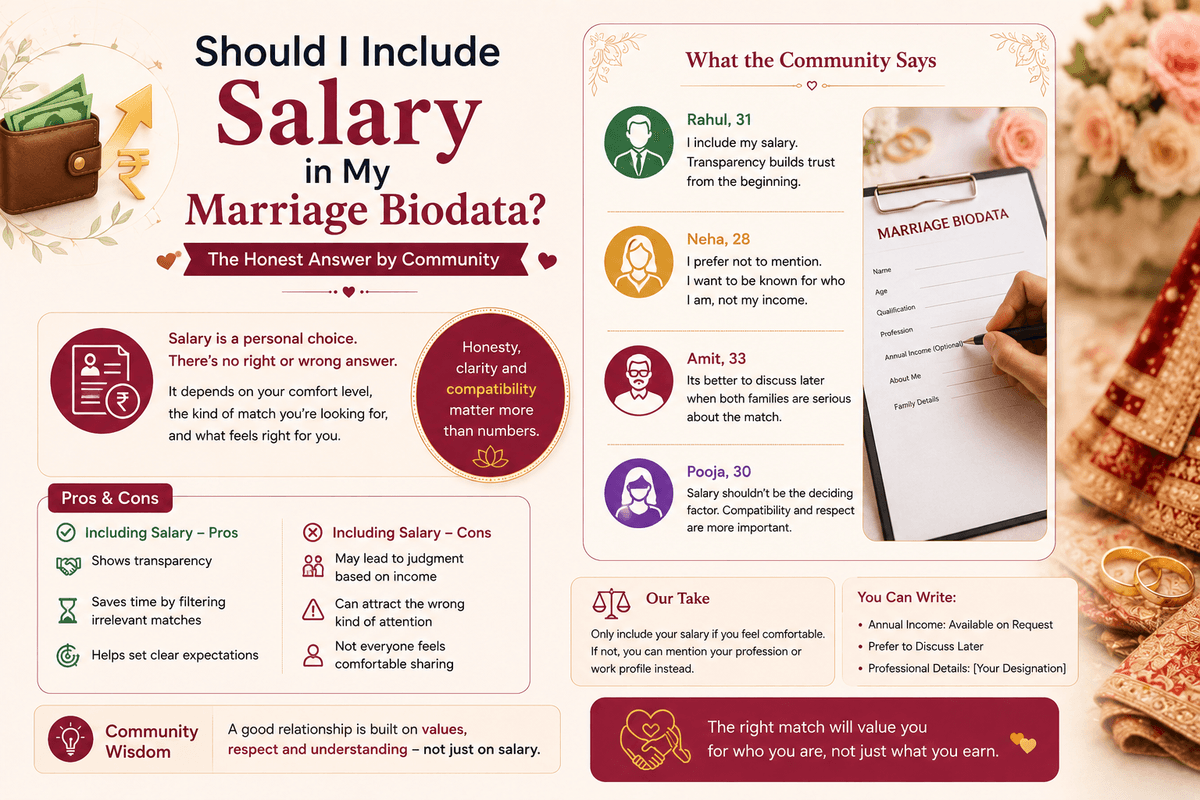
The Reddit debate that never ends
Search "salary in marriage biodata" in r/Arrangedmarriage and you find threads with hundreds of comments going back years. The debate has roughly three camps: include it because financial compatibility matters and transparency saves everyone's time; don't include it because it makes you look either too rich or too poor; or write a range and don't overthink it — this is not a big deal.
The third camp is right. The reason this debate generates so much heat is that salary carries enormous social weight in Indian culture — it signals not just earning capacity but education, career success, and social standing. That weight makes people overthink a field that should take thirty seconds to fill in. The nuanced reality is that the right answer varies by community, by career type, and by whether the candidate is a man or a woman — and this post covers all of them.
When including salary is clearly the right call
IT professionals and corporate employees in metro cities: if you work in software, finance, consulting, or professional services in a metro city, including a salary range is expected. Families evaluating these profiles are financially literate and factor in career trajectory alongside the current number. Write "Annual Income: 12–15 LPA," not "₹13,45,000."
NRI candidates — absolutely include it, in dual currency. For an NRI biodata, income is the most practically important field after visa status. An income figure in foreign currency alone confuses India-based families who don't have a sense of purchasing power parity. Both numbers together give the complete picture: "CA$88,000–100,000 per year (approx. ₹54–62 LPA)."
High-income candidates in sectors families will not intuitively associate with high salaries: a data scientist earning 25 LPA, a fintech product manager earning 35 LPA, a quant researcher earning 45 LPA — families from non-tech backgrounds may not associate these roles with these incomes. Stating the range removes an incorrect assumption and often produces a positive surprise. Business families presenting a candidate who works in the family business should write what is honest: "Family business (textile import-export, Surat) — annual draw ₹18–22 LPA."
When to leave salary out or write "details available on request"
Government officers and defence services: the pay grade system and cadre communicate status and compensation implicitly in a way a salary figure alone doesn't capture. Writing "IAS officer, currently posted as SDM, Rajasthan" communicates more than a rupee figure. Many government officer families simply write "Government service — details available on request."
Early career candidates under 3 years of experience: an entry-level salary is honest but risks the receiving family anchoring to a current number without accounting for trajectory. Write "Currently at entry level — details available on request" rather than suppressing an honest number or presenting one that doesn't represent your potential.
Candidates in niche, highly-paid roles families may not recognise: a principal engineer earning 80 LPA in ESOPs and base might face scepticism from traditional families who consider the number implausible. "Details available on request" protects against the disbelief problem that can arise from numbers that seem inflated even when accurate. Some candidates also simply prefer that money conversation to happen in person, after personal and family compatibility is established first — that preference is legitimate too.
The woman's salary question — the most complicated version
This deserves its own section because it generates the most discussion and the most anxiety. The specific scenario: a woman earns more than most men in her matrimonial circle — say, 20–30 LPA as a doctor, lawyer, or senior IT professional. Her parents worry that stating this will "intimidate" potential matches.
"My mum thought my 22 LPA salary would put families off. We put it in the biodata. The families who responded were exactly the ones we wanted to meet. The ones who would have been put off would have been incompatible anyway." — from a real matrimonial forum thread.
The honest analysis: hiding a woman's salary to avoid intimidating the boy's family protects against a very specific type of match — a family that is not comfortable with a high-earning wife. That type of match is almost certainly incompatible with a high-earning woman's life in any case. The salary figure is doing its job as a filter, not sabotaging a good match. The guidance: if you earn well and you are targeting educated, modern, urban families, include the salary range. If you are targeting traditional families where your parents believe income will genuinely work against the match, write "details available on request" — and make that choice consciously rather than from anxiety.
The one thing that gets people into trouble — exact figures
Whatever you decide about including salary, do not write an exact figure. Not "₹14,87,000." Not "₹15 LPA exactly." A range. Exact figures create a verifiability gap — LinkedIn salary range data and professional word-of-mouth mean families with corporate connections can often estimate whether a stated salary is plausible, and a figure that seems slightly rounded up is noticed. Exact figures also anchor negotiations incorrectly, and they don't capture total compensation — base salary, bonus, ESOPs, and reimbursements are often 25–40% above base, so a range is more honest to the actual experience of what the money feels like. Write a range, always.
Ready to create your own biodata? Start with our free builder or browse premium templates.