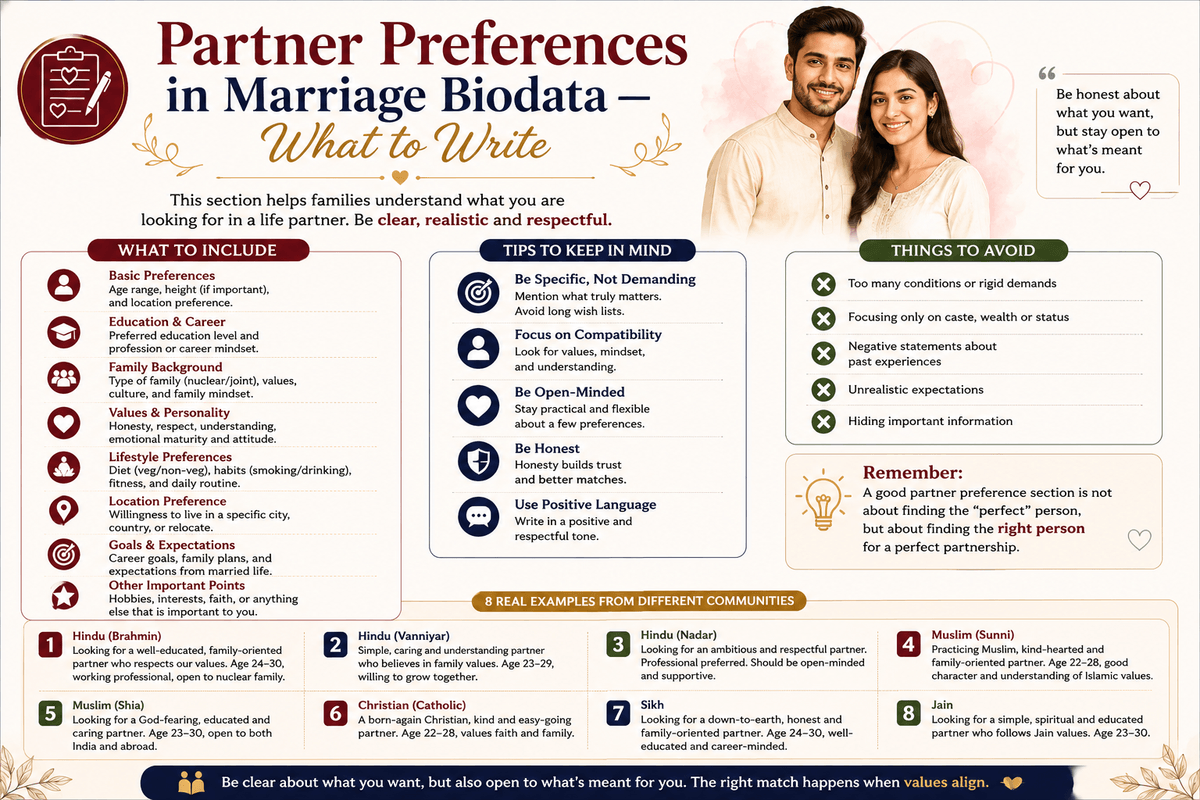
Why this section is harder than it looks
The partner preferences section is the only part of a marriage biodata where you talk about someone who does not exist yet. Every other section is factual — your name, your qualification, your family. This section requires you to describe, in a few sentences, what you are looking for in a life partner. That is actually a very intimate thing to put into words, especially for a document that strangers will read.
It explains why most people either write something completely generic ('educated, good family, family-oriented') that could describe anyone, or they overcorrect and list very specific requirements that sound cold on paper. Neither works. Unlike the About Me section, which at least gives you space to be a person, the partner preferences section often ends up reading like a filter. The other family reads it and does not feel welcomed. They feel screened.
The one thing that separates good partner preferences from bad ones
It is generosity. The best partner preferences sections are written as an invitation, not a gatekeeping list. They describe who you would genuinely love to meet — with room for someone real to fit into that description. The worst ones read as if the person is reviewing applications for a role with very specific minimum qualifications.
The checklist version: 'Looking for a working professional, earning minimum 8-10 LPA, height 5'4" and above, Masters degree, non-smoker, non-drinker, from a respectable family, willing to relocate to Pune.' The invitation version: 'Looking for someone who is educated and independent, close to their family, and open to building a life in Pune — though we are flexible on location for the right match. Career and qualifications matter to us, but warmth and honesty matter more.' Both communicate similar underlying preferences. One sounds like a job posting. One sounds like a person.
What you can actually mention — and how to frame it
Age: a range is standard. '27 to 32' or 'within 3 to 4 years' is the normal convention. Do not specify an exact age — it reads as inflexible. A generous range of 5 to 6 years is usually better than a tight one of 1 to 2 years.
Education: be specific about what actually matters to you, not what sounds impressive. 'Graduate or above' is honest if that is genuinely your preference. If your actual preference is 'someone who values education and keeps learning,' write that — it is more honest and more attractive.
Career and income: 'Working professional' is fine to state if it matters to you. Mentioning a specific salary figure can read as mercenary. 'Looking for someone who is settled in their career and financially independent' lands better than a rupee figure and communicates the same thing.
Height: you can mention it. 'Taller than me' or 'around 5'8" and above' is acceptable. What does not work is being extremely specific or making it the first thing you mention. If height matters, put it at the end and frame it lightly.
Community and caste: this is personal and honest preferences vary widely. If your family prefers a specific community, state it honestly — 'From the Deshastha Brahmin community' or 'Sunni Muslim family preferred' or 'Caste no bar, but similar values important.' Do not be vague about it if it matters — it wastes everyone's time. And do not apologise for it. It is a preference, not a judgment.
What not to mention: skin tone ('fair complexion preferred') — this will never read well in writing, even if it is an honest preference. Have this conversation after initial contact, not before. Also avoid negative statements like 'no divorcees' or 'no one from nuclear families' — if you have hard exclusions, have them as conversations, not written into the biodata.
8 partner preferences examples — real community voices
Male candidate, IT professional, Bengaluru, modern family: 'Looking for someone who is educated and working, close to her family, and comfortable with life in Bengaluru. We are an open-minded family — caste is no bar, though we would prefer a Hindu family with similar values. What matters most is honesty, warmth, and someone who is as genuinely close to her family as I am to mine.'
Female candidate, doctor, Delhi, traditional North Indian family: 'Looking for a professionally settled man from a good family, ideally working in a field that gives him reasonable stability and time — we understand demanding careers, but family time matters to us. We would prefer someone from a Brahmin family in North India, though we are open to discussing. Age between 28 and 32.'
Male candidate, bank officer, Lucknow, UP Brahmin: 'Looking for a well-educated girl from a respectable family, preferably from UP or adjoining states. She should be family-oriented and comfortable with a joint family setup, as we live with my parents. Caste: Brahmin. Age: 23 to 28. Career is not a requirement but education to at least graduate level is important to our family.'
Female candidate, CA, Pune, Marathi family: 'Looking for someone who is educated, settled in his career, and from a Marathi family — we are Brahmin (CKP) and would prefer someone from a similar background. He should be respectful of a working woman's career and comfortable living in Pune. Age between 28 and 34.'
Male candidate, Muslim professional, Hyderabad: 'Looking for a pious, educated woman from a good Sunni Muslim family. She should share our family's values of faith, education, and respectful living. We are Syed and would prefer someone from a similar background, but we are open to discussing. Based in Hyderabad or willing to relocate.'
Female candidate, IT professional, Chennai, Tamil Brahmin: 'Looking for a Tamil Brahmin man, ideally an Iyer, between 28 and 33 years of age. Education to at least graduate level; a professional career is preferred. Horoscope match (Jathagam porutham) is important to my family. Open to matches from Chennai, Coimbatore, or Bengaluru.'
Male candidate, second marriage, Pune, open tone: 'Looking for someone who is mature, independent, and emotionally settled. No hard requirements on age, background, or qualifications — the person matters more than the resume. Would prefer someone based in Pune or willing to be. Happy to share more details after initial contact.'
Female candidate, NRI, Toronto: 'Looking for someone who is comfortable with a life divided between India and Canada — visits home regularly, values family, but is also settled and independent abroad. We are open on caste and community. Education and career stability matter. Age between 28 and 36.'
What to do when your preferences and your family's preferences do not match
It happens in most families. The candidate has one set of preferences — open, broad, values-based. The parents have another — community, caste, height, income, specific states. The biodata ends up being a negotiation between what the candidate wants and what the parents are comfortable putting in writing.
Write the section yourself, then show your parents. Having something to react to is easier than starting from a blank page. Most parents will accept a reasonable, honest version of their preferences if it is already written and sounds respectful. Put the most important preferences first and the less important ones last — or leave them out entirely. You can always discuss specifics after the first contact. The biodata is not a contract.
Frequently asked questions
What should I write in the partner preferences section of a marriage biodata? Write 2 to 4 sentences describing the kind of person you are genuinely open to — values, education, career, location, family background. Be honest but generous — this section should read as an invitation, not a checklist. Mention what genuinely matters to you, not a complete list of every requirement. The other family should finish reading your preferences feeling that you are open to meeting real people.
Is it okay to mention height, caste, or income in partner preferences? Yes, with care about how you frame them. Height: mention it briefly, at the end, lightly. Caste or community: state it honestly if it matters to your family — vagueness wastes everyone's time. Income or career: mention stability preferences rather than a specific rupee figure ('settled in their career and financially independent' lands better than 'minimum 8 LPA'). Skin tone is the one preference to leave out of the written biodata.
How long should the partner preferences section be? Two to four sentences is ideal. Any longer and it starts reading as a demand list. Any shorter and it says nothing. The goal is to give the other family enough to know whether they would like to take the conversation forward.
What if I do not have strong preferences — should I just leave this section blank? Do not leave it blank. Write something simple and honest: 'Open to meeting someone who is educated, genuinely close to their family, and values warmth and honesty in a relationship. Caste and location are flexible for the right match.' Even a vague but genuine statement is better than nothing.
Ready to create your own biodata? Start with our free builder or browse premium templates.