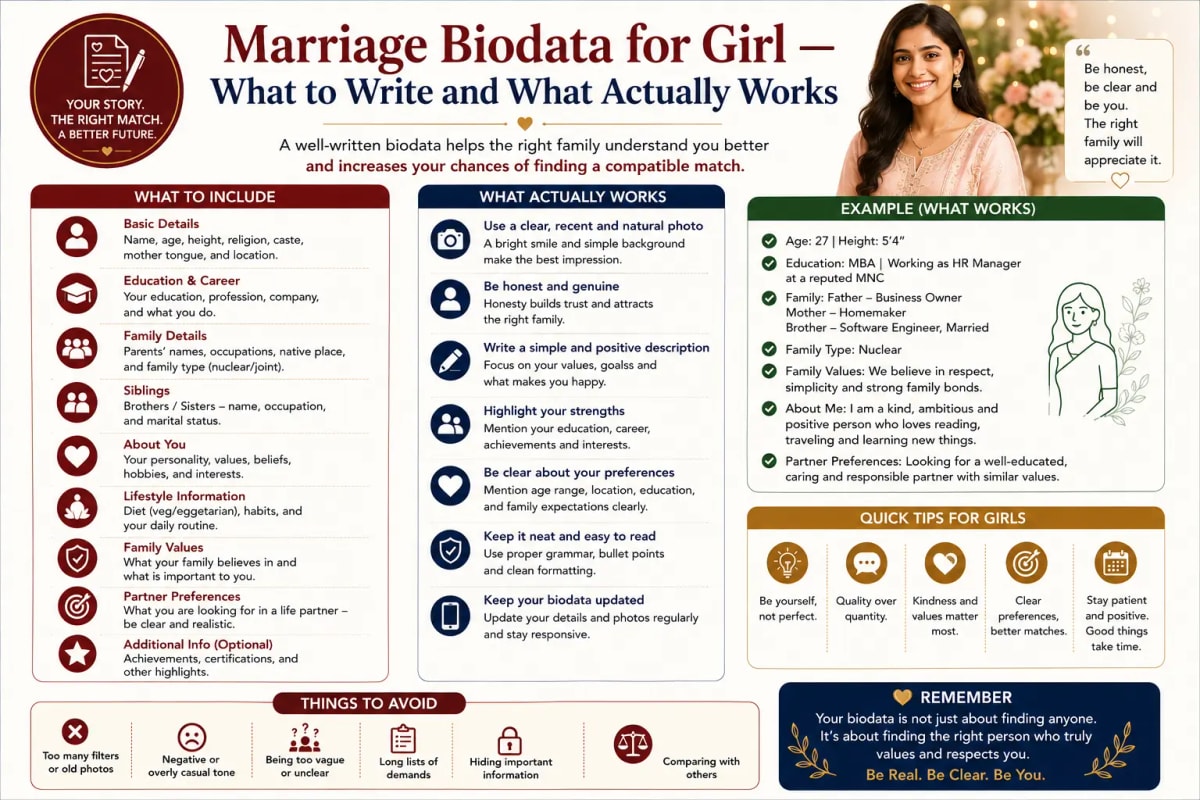
Is a girl's biodata really different from a boy's?
Structure: identical. Both have the same six sections in the same order — personal details, family background, education, career, About Me, partner preferences, contact.
What's different is emphasis — what the receiving family reads first, what they weight most heavily, and what they're looking for in each section. For a boy's biodata, families scanning quickly tend to go: photo → qualification/career → family background. Income and professional stability are often the first filter. For a girl's biodata, families tend to go: photo → About Me → family background. Who she is as a person, and what kind of family she comes from, often precedes the professional scan.
This is not a rule. Urban families, progressive families, and second-marriage contexts all operate differently. But it's a pattern that comes up consistently in community feedback on platforms like Reddit's r/Arrangedmarriage and in matrimonial WhatsApp groups — and it has practical implications for how a girl's biodata should be laid out and what each section should prioritise.
The photo — what works specifically for a girl's biodata
There's a specific tension girls face with the biodata photo: pressure from family to look traditional, personal preference to look like themselves, awareness that the photo will be judged before the name is read.
The honest guidance: you don't need to wear a saree or a heavy salwar kameez unless that's genuinely what you wear. A simple kurta, a formal shirt, even western wear if that's your everyday — all fine. What families are actually looking for in the photo is warmth and genuineness, not traditional dress specifically.
Heavy bridal or semi-bridal makeup for a biodata photo is too much. It creates an expectation that the first meeting can't match. Natural or light makeup reads as honest. On the question of expression: a warm, natural look is correct — not the full formal unsmiling pose that reads as cold, and not the wide posed grin that looks performative.
One consistent pattern from community feedback: the photo with a visible Instagram filter. Mothers reviewing biodatas for their sons notice this immediately and find it unsettling — it reads as hiding something. Whether or not that's rational, it's consistent. A recent, unfiltered portrait in natural light is the right call every time. For a detailed photo guide, read /blog/biodata-for-marriage-photo-tips.
Should you mention your salary in a girl's marriage biodata?
The case for including it: you earn well, you're financially independent, and many modern families — especially those with educated, professional sons — actually want to see this. It signals that the family isn't entering the marriage from a dependent financial position. Families in metros, Tier-1 cities, and IT/corporate circles often expect this field to be filled.
The case for leaving it out: some families — particularly traditional ones, or those where the son earns significantly more or significantly less — may react badly to a girl's salary being prominently stated. This is not a rational concern, but it's a real one in certain contexts. If your target families are traditional, your parents may advise leaving it out.
The practical middle ground: include a salary range if you're comfortable and if the families you're targeting are modern or urban. If you're targeting traditional families, leave it out or write 'comfortable, details available on request.' Don't omit your salary because you think ambition is unattractive — families who would penalise you for earning well are probably not families you want to marry into.
The About Me section — the specific version for a girl's biodata
This is where most girls' biodatas fail, and for a very specific reason: they're written by parents trying to present their daughter as 'ideal' rather than by the daughter trying to present herself as real.
The result is a standard set of phrases that appear in almost every girl's biodata: 'She is a homely, family-oriented girl who is good at cooking and adjustable in nature.' From the outside, this reads as: this biodata was written by her parents. The word 'adjustable' — which appears in an astonishing number of girls' biodatas on BharatMatrimony and Shaadi.com — has come to signal that the family is presenting their daughter as someone who will fit into whatever situation she's placed in. Whether that's actually true is a separate question. The word itself lands badly with modern receiving families.
What works instead: one paragraph in first person, in the girl's own voice, with one specific thing that's true about her. 'I'm a paediatrician at a hospital in Pune — the job is demanding but it's also the part of my life I'm most proud of. I cook on Sundays when I can, and my dal tadka is better than my mum's (she agrees). I'm close to my family in Nashik and try to be home every month. I'm looking for someone who respects a working woman's schedule and values family the same way I do.' That paragraph says more in five sentences than three paragraphs of adjectives. It also has one detail nobody else will have — the kind of specific, human line that makes a family think: she sounds real. For the full method, read /blog/how-to-write-about-me-in-marriage-biodata.
Willingness to relocate — do you have to write it?
One of the most common points of conflict between girls and their parents when filling in a biodata. The parent wants to write 'willing to relocate' to maximise the candidate pool. The girl is not sure she wants to relocate for someone she hasn't met. Both are reasonable positions.
If you're genuinely open to relocation: write it. 'Open to relocation depending on the match' or 'based in Delhi, open to discussing location' is honest and non-committal in a reasonable way. If you're genuinely not open: don't write it. The conversation about location is much better had after initial contact and some mutual interest. If you're uncertain: write nothing in the location field, or write 'based in [city], open to discussion.' That's accurate and commits you to nothing.
Career and ambitions — how to mention them without losing the match you want
A recurring concern for girls with strong professional identities: how to present a career without making traditional families think you'll be 'difficult.' The honest answer: if a family will reject your biodata because you have a career and career ambitions, they're not compatible with your life. The biodata is doing its job — filtering.
But there is a way to mention career that tends to land better across both modern and traditional families: pair the professional fact with a family-connected fact. 'I'm a software engineer at a company in Bengaluru — I enjoy the work and I'm good at it. Family comes first though — I talk to my parents every day and I try to be home in Ludhiana at least once a month.' The career is stated clearly. The family connection is stated clearly. Nobody is asked to make a choice between them. This is more persuasive than a biodata that hides the career or one that leads with it as the only identity.
A complete sample girl's marriage biodata — Hindu family, North India
Personal Details — Name: Priya Sharma. Date of Birth: 14 March 1998 | Time: 7:20 AM | Place: Kanpur, UP. Rashi: Meen | Nakshatra: Revati | Gotra: Kashyap | Manglik: No. Height: 5'4" | Blood Group: B+. Religion: Hindu | Caste: Brahmin (Kanyakubj) | Mother Tongue: Hindi.
Education & Career — Qualification: B.Tech, Computer Science — IET Lucknow (2020). Current Role: Software Engineer, TCS — Noida. Annual Income: 7–9 LPA.
Family Details — Father: Rakesh Sharma — Retired Govt. Officer. Mother: Sunita Sharma — Homemaker. Siblings: One elder brother (married, settled in Delhi). Family Type: Nuclear | Native Place: Unnao, UP. Family Values: Simple, close-knit, rooted in tradition.
About Me — I'm a software engineer in Noida who finds genuine satisfaction in the work — and equally genuine satisfaction in the Sunday phone calls home to Kanpur. I cook badly but enthusiastically. I read when I get the time, mostly non-fiction. I'm looking for someone who is grounded, close to his family, and isn't threatened by a woman who has her own career and ideas.
Partner Preferences — Looking for an educated, professionally settled Hindu (Brahmin preferred) man between 27 and 32 years of age. He should be family-oriented and comfortable with a working wife. Location: open to Delhi NCR or Kanpur. Caste is preferred but not a hard requirement for the right match.
A complete sample girl's marriage biodata — Muslim family, Hyderabad
Personal Details — Name: Sana Fatima. Date of Birth: 22 July 1997 | Place: Hyderabad, Telangana. Height: 5'3" | Mother Tongue: Urdu/Telugu. Religion: Islam | Sect: Sunni | Biradari: Syed.
Education — MBBS — Osmania Medical College, Hyderabad (2022). Currently: Completing MD, Internal Medicine.
Family Details — Father: Dr. Mohammed Yusuf — Physician (Private Practice). Mother: Rukhsana Begum — Homemaker. Siblings: One younger brother (student). Family Type: Nuclear | Native: Hyderabad (Old City).
About Me — I'm completing my MD in Hyderabad and hope to practice internal medicine here. Medicine is what I was raised around — my father has been a doctor for 30 years — so it isn't just a career, it's part of who we are as a family. I pray five times a day and my faith is important to me, though I'm not rigid about others. I'm looking for someone who is educated, kind, and serious about family.
Partner Preferences — Looking for a Sunni Muslim man, preferably Syed, between 28 and 34 years of age. Should be educated and professionally settled. Based in Hyderabad preferred, though open to the right match elsewhere. Photo shared on request. Contact Person: Dr. Mohammed Yusuf (Father).
Frequently asked questions
Is a girl's marriage biodata different from a boy's? The structure is the same — personal details, family background, education, career, About Me, partner preferences, contact. The difference is in what receiving families read first. For a girl's biodata, families often go to the About Me and family background before checking qualifications and career. This means those two sections carry extra weight and should be written with care.
Should a working girl mention her salary in a marriage biodata? It depends on the families you're hoping to attract. Urban, professional, modern families expect to see it and may actually value a working girl's income. Traditional families may prefer it left out. A middle ground: include a range if you're comfortable, or write 'details available on request.' Don't omit your salary because you think ambition is unattractive — families who think that way are probably not compatible with your life.
What should a girl write in the About Me section of her biodata? Write it yourself, in first person, with one specific true detail. Not 'I am a homely, family-oriented girl who loves cooking.' Instead: something real — one genuine hobby, one fact about your relationship with your family, one sentence about what you're looking for. One specific detail that only you would write is worth more than three sentences of adjectives that every biodata shares.
Does a girl's biodata need to say 'willing to relocate'? Only if you genuinely are. Don't write it to maximise your candidate pool if you're not actually open to moving — the conversation about location is much better had after mutual interest is established. If you're uncertain, write 'based in [city], open to discussion.' That's honest and non-committal in a reasonable way.
Ready to create your own biodata? Start with our free builder or browse premium templates.