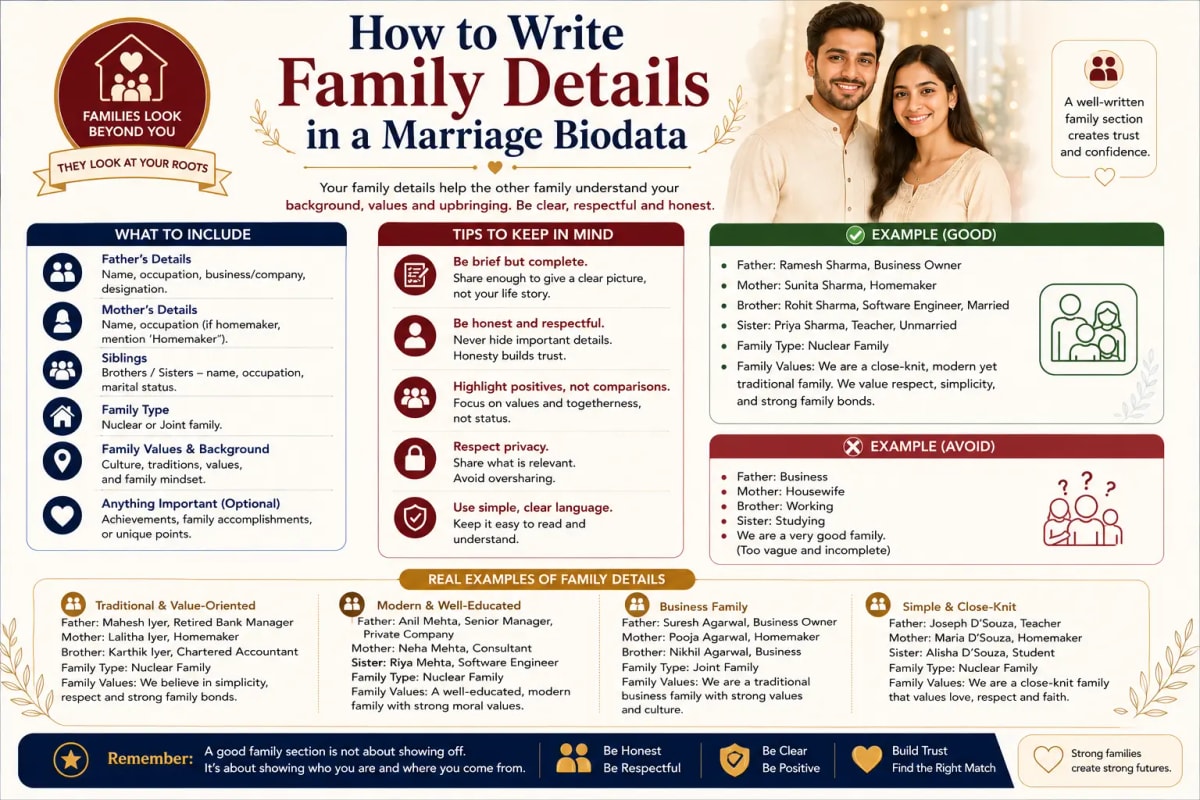
Why families read this section so carefully
When a family reviews a biodata, they're trying to answer one underlying question: what kind of people am I connecting my child to? The education and career section answers: what is this person's financial and professional situation? The About Me answers: what kind of person are they? But the family background section answers something deeper — what kind of household does this person come from? Are the parents present and stable? Are the siblings settled? Is this a family we can trust, build a relationship with, have in our home?
This is why a family background section written with warmth and specificity does more to move a biodata from 'considered' to 'let's call them' than almost anything else. And why a section that reads as just a form — name, occupation, done — leaves the receiving family with no feeling at all. This pattern comes up consistently across Reddit's r/Arrangedmarriage, Quora matrimony threads, and parents' feedback in matrimonial WhatsApp groups.
What to include — field by field
Father's name and occupation
Full name. Not 'Father: Sharma.' Full name. For occupation, be specific but not clinical: 'Retired IAS Officer' is better than just 'Retired' or 'Government Service.' 'Owns a cloth business in Surat, established 1989' tells a family much more than 'Business.' 'Farmer — agricultural land in Vidarbha' is honest and should not be hidden — farming families often have strong community networks that receiving families value. 'Retired School Principal, Gorakhpur' places the family in a cultural and geographic context that families find meaningful.
If your father passed away: write 'Late Shri [Name] — [occupation during his lifetime].' The word 'Late' is the standard convention in Indian matrimonial biodatas. It is honest, respectful, and acknowledged without requiring elaboration in the document.
Mother's name and occupation
Full name. For occupation: 'Homemaker' is the correct and respectful term. Not 'housewife.' Not 'domestic duties.' Homemaker. If your mother works, state it specifically — 'Teacher, Govt Primary School, Nashik' or 'Runs a tiffin service from home.' If your mother has passed away: same convention — 'Late Smt. [Name].'
Siblings
List the number with married or unmarried status and — briefly — what they do if it's relevant: 'One elder brother — married, software engineer in Bengaluru.' 'One younger sister — pursuing MBBS, Pune.' 'Two sisters — both married and settled.' You do not need to name siblings in most biodata formats unless it's a traditional community where names are expected. The relevant information is: how many, what gender, married or not, roughly what they do.
What about a divorced sibling? The honest answer: a divorced sibling is not your business to hide, but it's also not necessary to volunteer in a first-introduction document. If it's been years and the sibling has moved on with their life, 'one brother — divorced, remarried, settled in [city]' is completely honest and doesn't need to be made into a bigger deal than it is. Families who would penalise you for your sibling's life choices are families worth filtering out early.
Family type — joint or nuclear
Joint family: you live together with parents and possibly grandparents, siblings, under one roof or closely connected. Nuclear family: parents and children only, living separately. The question that trips people up: 'We live separately from my parents but we spend every weekend together and are extremely close. Are we joint or nuclear?' Write: 'Nuclear family, closely connected — parents live nearby.' This is honest and actually says more than either label alone. Many receiving families — especially those who value family ties — respond well to this phrasing.
Native place
The ancestral village or hometown, even if the family has been in a city for decades. 'Native: Balia, UP (settled in Mumbai for 30 years)' gives the receiving family two pieces of information: where the family's roots are and that they're established in Mumbai. Both are useful. For South Indian families, native place carries significant weight — people ask 'which district?' not just 'which state.' Write specifically: 'Native: Thanjavur, Tamil Nadu' or 'Native: Warangal, Telangana.' For Marathi families, the Kul and Kulswamini fields belong in the same section. For families that have been urban for three or more generations and genuinely don't have a native village: 'Native: [city]' is fine — don't invent an ancestral village.
How to make this section feel warm — not just factual
Most family details sections read like a tax form: name, occupation, status. Done. The family details section that actually works reads like a brief, warm introduction to the household. One or two sentences after the factual fields can do a lot of work.
This doesn't mean writing paragraphs. It means something like: 'We are a close joint family of six in Lucknow — my grandparents, parents, younger brother, and me. My father retired from the Railways three years ago. We live in the same house we've been in for forty years. We are a simple, rooted family.' Those four sentences tell a receiving family: this is a stable, multi-generational household. The family has been in one place for a long time — they have roots. The father's retirement is stated without embarrassment. The 'simple, rooted' characterisation signals values without preaching about them.
Contrast with: 'Father: Ramesh Kumar, Retired. Mother: Usha Devi, Homemaker. Siblings: One brother. Family Type: Joint.' Same facts. No warmth. No sense of who these people are. The receiving family finishes reading and feels nothing.
Sensitive situations — handled with honesty
Deceased parent: write 'Late Shri/Smt [Name] — [former occupation].' This is standard in Indian matrimonial biodatas. The receiving family will understand and will not ask about it insensitively in initial contact. If the death was recent, you may want to add a brief sentence in the cover message when sending the biodata — but this is a choice, not a requirement.
Separated or divorced parents: write whichever parent is the contact person and managing the marriage process as the primary contact. You are not obligated to announce the separation in a first-introduction biodata. If it comes up in conversation — and it will, at the right time — you handle it then. A biodata is not a full disclosure document.
Single parent (widowed, divorced, or never married): state the situation clearly but briefly. 'Father passed away in 2018. Mother, Meera Devi, manages our household and is the contact person.' This is honest, warm, and doesn't over-explain.
Parent with an occupation the family feels self-conscious about: don't hide it, but do frame it honestly. 'My father runs a general store in our hometown' is fine. Families who would judge someone for their father's occupation are families worth discovering early. The biodata is doing its job.
Two sample family detail sections — traditional and modern
Sample 1 — Traditional joint family, North India: Father: Shri Ram Prakash Mishra — Retired Bank Manager (SBI), Varanasi. Mother: Smt. Sharda Mishra — Homemaker. Siblings: One elder sister — married, settled in Allahabad. One younger brother — pursuing B.Tech, Kanpur. Family Type: Joint — we live with my grandparents and paternal uncle's family. Native Place: Ballia, UP (family settled in Varanasi for three generations). 'We are a traditional, close-knit Brahmin family with deep roots in Varanasi. My grandfather was a Sanskrit teacher; education and family values have always been central to our household.'
Sample 2 — Nuclear family, urban professional, South India: Father: Mr. Suresh Iyer — Senior Manager, HDFC Bank, Chennai (35 years in banking). Mother: Mrs. Lakshmi Iyer — Retired Teacher. Siblings: One elder brother — married, IT professional, Bengaluru. Family Type: Nuclear — parents in Chennai, brother in Bengaluru. Native Place: Thanjavur, Tamil Nadu. 'We are an Iyer family, originally from Thanjavur, settled in Chennai for two generations. My parents are well-educated, well-connected in the Chennai Tamil community, and very involved in the marriage process.'
Frequently asked questions
What should I write in the family details section of a marriage biodata? Include: father's full name and occupation, mother's full name and occupation, siblings with married or unmarried status, family type (joint or nuclear), and native place or ancestral village. Write it with some warmth — a sentence or two after the factual fields describing the household can do a lot to make the family feel real to the reader.
My father is retired — what do I write for his occupation in the biodata? Write his last position, not just 'Retired.' 'Retired IAS Officer,' 'Retired School Principal,' 'Retired Bank Manager — SBI' tells the receiving family something meaningful. Just 'Retired' tells them nothing and may accidentally imply the family is in financial difficulty, even when it's not.
What do I write if a parent has passed away? Write 'Late Shri/Smt [Full Name] — [former occupation].' This is the standard convention in Indian matrimonial biodatas. It's honest and respectful. The receiving family will understand. You do not need to explain further in the biodata itself.
Should I write joint or nuclear family if we don't live together but are very close? Write 'Nuclear family, closely connected — parents live nearby' or 'Nuclear family — we meet every week.' This is more honest and more informative than either label alone. Many families value knowing that you're close to your parents even if you don't technically live together.
Ready to create your own biodata? Start with our free builder or browse premium templates.