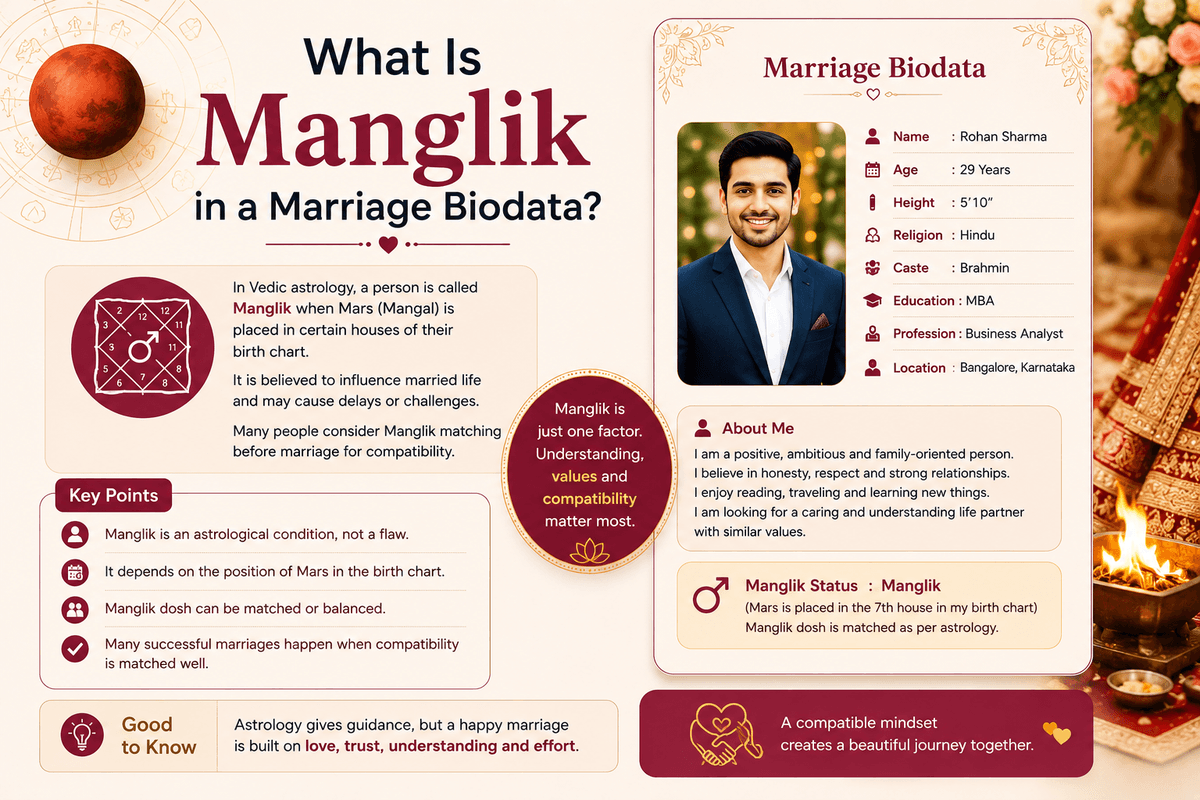
Where Manglik comes from — the actual explanation without mysticism
Mars (Mangal) in Vedic astrology governs energy, aggression, drive, and conflict. It is considered a malefic planet — not evil, but intense and forceful. When Mars occupies the 1st, 4th, 7th, 8th, or 12th house of a Vedic birth chart, its intense energy is believed to affect the house of partnership (7th), longevity (8th), and the general household (4th) — all of which are directly relevant to married life.
The word "Manglik" comes from Mangal, the Sanskrit name for Mars. Kuja Dosha is the South Indian name for the same condition — "Kuja" also means Mars.
- 1st house (Lagna): Mars in the house of self makes the person strong-willed and self-asserting — potentially challenging in a traditional marriage context where the expectation is accommodation.
- 4th house: The house of home, domestic happiness, and mother.
- 7th house: Directly the house of marriage and spouse.
- 8th house: The house of longevity, hidden matters, and transformation.
- 12th house: The house of loss, isolation, and foreign lands.
Mars in any of these houses is considered to bring its intense, forceful energy to bear on the marriage relationship specifically. This is the logic — it is not superstition but a structural reasoning within Vedic astrology's framework. In South Indian Jyotisha (used extensively in Tamil, Telugu, and Kannada-speaking communities), the 2nd house is also included — so six houses rather than five are checked. This increases the Manglik proportion to roughly 50%. When your biodata is going to a South Indian family, they may check using their own tradition.
How common is Manglik — the number that changes everything
Roughly 40% of people are Manglik using the standard North Indian 5-house calculation. Let that sit for a moment. Not 5%. Not 10%. Four in ten. If you are in a room of ten people and you pick any one of them at random, the probability is nearly 50% that they are Manglik.
This number comes from the mathematics of the birth chart: Mars occupies one house in your chart at birth, and there are 12 houses total. Five houses create Manglik status — 5 out of 12 is roughly 42% before factoring in planetary distribution, which varies slightly. The South Indian 6-house calculation puts it closer to 50%.
This has two practical implications. First, Manglik-Manglik matches are very common — if 40-50% of people are Manglik, then among any group of Manglik candidates, roughly half the potential matches will also be Manglik, and the concern resolves itself naturally. Second, blanket rejection of Manglik candidates is statistically counterproductive — a family that refuses to consider any Manglik candidate for their Non-Manglik child is filtering out roughly 40% of the potential match pool. In practice, very few families with marriageable children between 27 and 35 apply this absolutely — most check, note it, discuss it with a Jyotishi, and proceed if other factors are strong.
The Manglik cancellations — what your Jyotishi will check
The list of conditions that cancel or reduce Manglik dosha is well-established in Vedic astrology literature, though different Jyotishis prioritise different cancellations. The primary and most universally accepted cancellation: both the boy and girl are Manglik. Mars in both charts — the dosha is considered to cancel itself, like two negatives producing a positive.
- Mars in its own signs — Aries (Mesha) or Scorpio (Vrishchika) — is considered powerful and less likely to cause harm, reducing or cancelling the dosha in many traditions.
- Mars in exaltation — Capricorn (Makara). An exalted Mars in a malefic house is considered less damaging than a debilitated Mars.
- Mars aspected by Jupiter (Guru), the great benefic — believed to moderate Mars's aggressive energy.
- Mars in the 1st house for Aries Lagna — for someone born with Aries rising, Mars rules the Lagna and its placement there is considered much less harmful.
- Saturn aspecting or conjunct Mars — in some traditions, Saturn's presence controls Mars's volatility.
- Rahu or Ketu conjunct Mars — in some South Indian traditions, this neutralises the dosha.
The practical advice: do not try to determine your cancellations from a calculator or this article. Cancellation assessment requires looking at the full chart, not just Mars's house position. If Manglik status is creating concern in your matrimonial process, have a trusted Jyotishi — not a random online service — review the complete chart. A 30-minute consultation is worth more than any calculator.
Partial Manglik — what is it?
Some biodata forms, matrimonial platforms, and families use a third category: "Partial Manglik." This is not universally standardised in Vedic astrology — it is a practical convention used to distinguish full Manglik (Mars in the 7th or 8th house, considered the most directly marriage-relevant houses) from Partial Manglik (Mars in the 1st, 4th, or 12th house, which some Jyotishis treat as less severe).
There is also a different use of "Partial Manglik": when the Manglik calculation gives a "Yes" in one tradition (South Indian 6-house) but "No" in another (North Indian 5-house). Some families write "Partial Manglik" to acknowledge this ambiguity honestly. If your Manglik status is genuinely unclear, write "Partial Manglik" and be ready to explain in conversation that this reflects a borderline placement. Do not write "Non-Manglik" if any tradition would call you Manglik.
What to write in the biodata field — the exact guidance
If you are confirmed Non-Manglik: write "Non-Manglik." If you are confirmed Manglik: write "Manglik." Do not add qualifiers in the biodata field — save that for conversation; the biodata is for first-pass assessment, the conversation is for nuance. If you are Partial Manglik or borderline: write "Partial Manglik." If you do not know: use our free horoscope calculator to check — /horoscope-calculator. Enter your date, time, and place of birth and get your Manglik status calculated.
Some families, particularly in urban professional contexts, leave horoscope fields out entirely — the biodata says "Religion: Hindu" and the horoscope section is blank. This is a legitimate choice; the families who need Manglik status to assess compatibility will ask for it. What is NOT okay: filling in the horoscope section with Rashi and Nakshatra but leaving Manglik blank specifically. A selective blank on Manglik reads as exactly what it is — avoidance. It draws more attention to the issue than simply writing "Manglik" would.
The Bollywood problem — why Manglik is more feared than it deserves
Hindi films have played Manglik status for laughs and drama for decades, and folk remedies for Manglik dosha occasionally circulate widely in the news. None of this reflects how most Indian families — even traditional ones — actually use Manglik status in matrimonial decisions today.
"My mum mentioned Manglik, the astrologer said it was cancelled because my dad is also Manglik, and we moved on. The whole thing took about ten minutes." — from a real r/Arrangedmarriage thread.
The pattern across real accounts: families that care about Manglik status verify it through their own Jyotishi, assess cancellations, and make a decision that accounts for the full chart. The ones who reject based on the biodata checkbox alone are the exception, not the rule. And those families self-select out of a process they were never going to agree to — which is fine.
Ready to create your own biodata? Start with our free builder or browse premium templates.