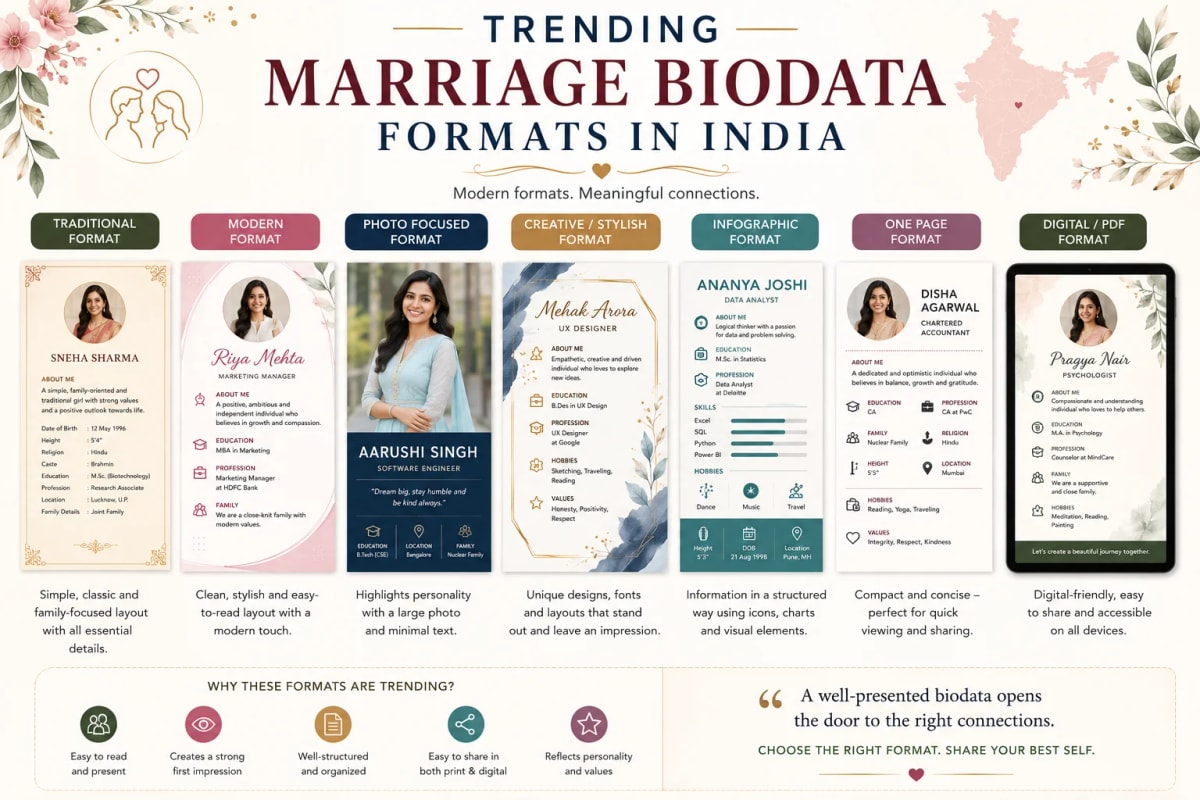
Why Minimalist Biodata Designs Are Replacing Traditional Formats in India
The old process — going to a shop, having someone type up details, printing copies, sending through relatives — took days and required sharing personal information with strangers. Online tools changed this by letting families create, edit, and share a profile in minutes from home. Privacy matters: a family in a smaller city does not want their daughter’s photo and contact details handled by a local print shop. Creating the profile themselves on a dedicated platform keeps control with the family. The WhatsApp culture accelerated this further — a PDF sent in seconds to a relative in another city, ready to read immediately. The modern format is online, self-created, PDF-first, and WhatsApp-ready.
Preference of One-Page Biodata Formats
A two-page profile loses most readers on the second page in WhatsApp preview. Families in Delhi and Mumbai matrimonial groups are reviewing 20 to 30 profiles simultaneously. The scroll habit on mobile means page 2 is almost never seen unless the first page created a strong enough impression to make the reader scroll back and open the full PDF. One A4 page is not a limitation — it is the format families actually consume. When your profile does not fit a single page, cut in this order: long About Me sections (families skim these — a two-sentence version works better than eight sentences), duplicate contact information repeated in multiple sections, and decorative blank space that the design template inserted but carries no information. Every line that stays should earn its place.
Regional and Cultural Biodata Formats in India
Regional differences in how biodata profiles look are primarily visual, not just about fields. North Indian families — particularly in UP, Bihar, Delhi, Rajasthan — tend toward warmer color palettes: gold borders, maroon headers, cream backgrounds. The aesthetic reflects the visual language of traditional printing, wedding cards, and festive materials from that region. South Indian families — Tamil Nadu, Kerala, Karnataka, Andhra — tend toward cleaner, more minimal layouts with more white space. The Marathi printing tradition has its own ornamental character: specific border patterns and the Devanagari script aesthetic that distinguishes a Lagnacha Biodata from a North Indian shadi biodata. Understanding these visual regional differences helps you choose a design that feels right to the receiving family, not just to you.
AI-Generated Vs Creating Via Dedicated Platforms
AI tools are general-purpose and biodata creation is highly specific. When you ask an AI to create a biodata, it does not know that a Hindu family needs Gotra, Rashi, Nakshatra, Nadi, Gan, and Manglik status fields — or that a Marathi family needs Kul, Kulswamini, and Mulchi Gavi — or that a Muslim family’s profile should open with Bismillah. It generates a generic CV-style document with no community context. The output is not optimised for WhatsApp compression — dark backgrounds, small text, and complex layouts that look fine in an AI preview but become unreadable after PDF sharing. Data privacy is a concern: to generate your profile, you enter your family’s personal details into an external AI system. With a dedicated tool, your data stays in your browser and never leaves your device. The templates are already built for Indian communities, the fields are already labelled in the right language, and the PDF output is already tested for WhatsApp readability.
Trending Formats by State — What is Working in 2026
Delhi and NCR: Two-column minimal layouts with a prominent photo on the right are getting the best responses in WhatsApp matrimonial groups. High contrast (dark text on white) works better than tinted backgrounds. Mumbai: Clean modern designs without heavy borders — families here tend to see over-decorated designs as old-fashioned. The Modern and Sea Green Contrast designs are consistently well-received. Chennai and Bengaluru: Photo-right layouts with a prominent horoscope section. The Leafs Effect and Modern designs work for urban families; for traditional families sharing through a pandit or marriage bureau, something with more visual formality. Lucknow, Kanpur, and other UP cities: Sober Blue Gold and Crimson Swirl Contrast — both read as respectful and family-appropriate in the traditional North Indian arranged marriage context. Browse and preview all designs at marriagebiodatahub.com/templates.
Final Thoughts
Ready to create your own biodata? Start with our free builder or browse premium templates.