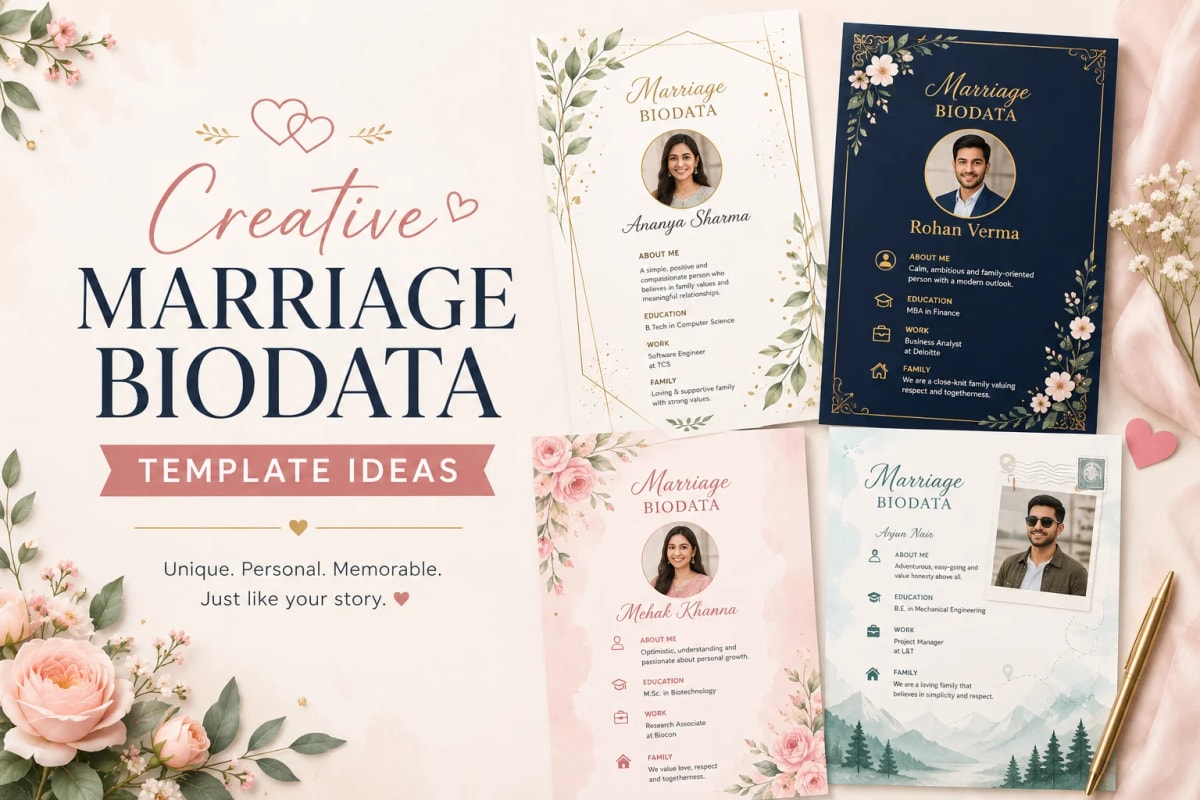
Features of Premium Biodata Template
What makes a design premium in 2026 is not just ‘professional layout’ — it is in the details that survive compression and printing. Micro-ornamental corner details that print crisply at 300dpi without turning into blotches. Photo frame shapes (oval, arch, circular) that read clearly at thumbnail size when shared in a WhatsApp group preview. Section dividers that are visible at 72dpi mobile screen resolution, not just in an editor. Cultural motifs — Bismillah calligraphy for Muslim families, mandala borders for Hindu families, Kolam patterns for South Indian families — that feel authentic rather than decorative. These are the creative details that families notice without being able to name them. The layout is the frame; these micro-details are what elevates the impression.
Biodata Template Ideas for Boys
The right design depends more on where the profile will be shared than on gender preference alone. For a 28-year-old software engineer in Bengaluru creating his own biodata for online matrimonial profiles: choose Nutan or Neel — both put career and education prominently, and the clean layout reads well on phone screens. For a 25-year-old in Lucknow whose parents are creating the profile for distribution through a matrimonial bureau: Rajasvi or Kumkum read as formal and family-approved — the kind of design that works on a printed A4 sheet left on a relative’s table. For an NRI groom creating a profile for international sharing: Shvetambar photographs well in soft lighting and prints without losing detail.
Biodata Template Ideas for Girls
For a doctor in Chennai whose family wants the Jathagam section to be prominent: the Nutan design keeps the horoscope section clean and structured — nothing is hidden, nothing competes for attention. For a Marathi girl in Pune whose family will share the profile with a local pandit: Kanakamala — it prints beautifully on glossy paper and feels traditionally appropriate without being heavy. For a girl from a Punjabi family in Delhi who wants something that stands out in a WhatsApp matrimonial group: Shvetambar has the highest contrast ratio of all our designs and gets noticed in a scrolling preview. For a software professional in Hyderabad sharing on an online platform: the Peepal design is modern without looking corporate.
Creative Mistakes to Avoid in Your Biodata Design
These are creative and visual mistakes — not content mistakes. Using an Instagram-filter profile photo: high-saturation, heavily edited photos look artificial in print and reduce trust. A plain, natural-light photo against a neutral background works better. Choosing a dark background design when you know the profile will primarily be shared on WhatsApp: dark templates look beautiful on screen but become unreadable when WhatsApp compresses the PDF for preview on a 5-inch screen — the dark areas merge and text disappears. Picking script or display fonts that render beautifully in a browser but break when the PDF is opened on an Android device with a different font stack. And finally, sending an English-only design to a family that primarily speaks Hindi or Marathi — a mismatch in cultural presentation creates an unnecessary barrier before the family has even read a single detail.
How to Select the Perfect Biodata Template
The fastest way: answer two questions. One — is the family network traditional or modern? Two — will the profile be shared on WhatsApp or printed for in-person delivery? If traditional + WhatsApp: choose a high-contrast design with cultural elements — Kumkum or Rajasvi. If modern + WhatsApp: choose Nutan or Neel — minimal layouts read best in compressed previews. If traditional + print: Kanakamala or Hilal both print at A4 without losing ornamental detail. If modern + print: Peepal or Tulsi both hold detail at 300dpi. Browse all options and filter by community on our templates page at marriagebiodatahub.com/templates.
Final Thoughts
Ready to create your own biodata? Start with our free builder or browse premium templates.