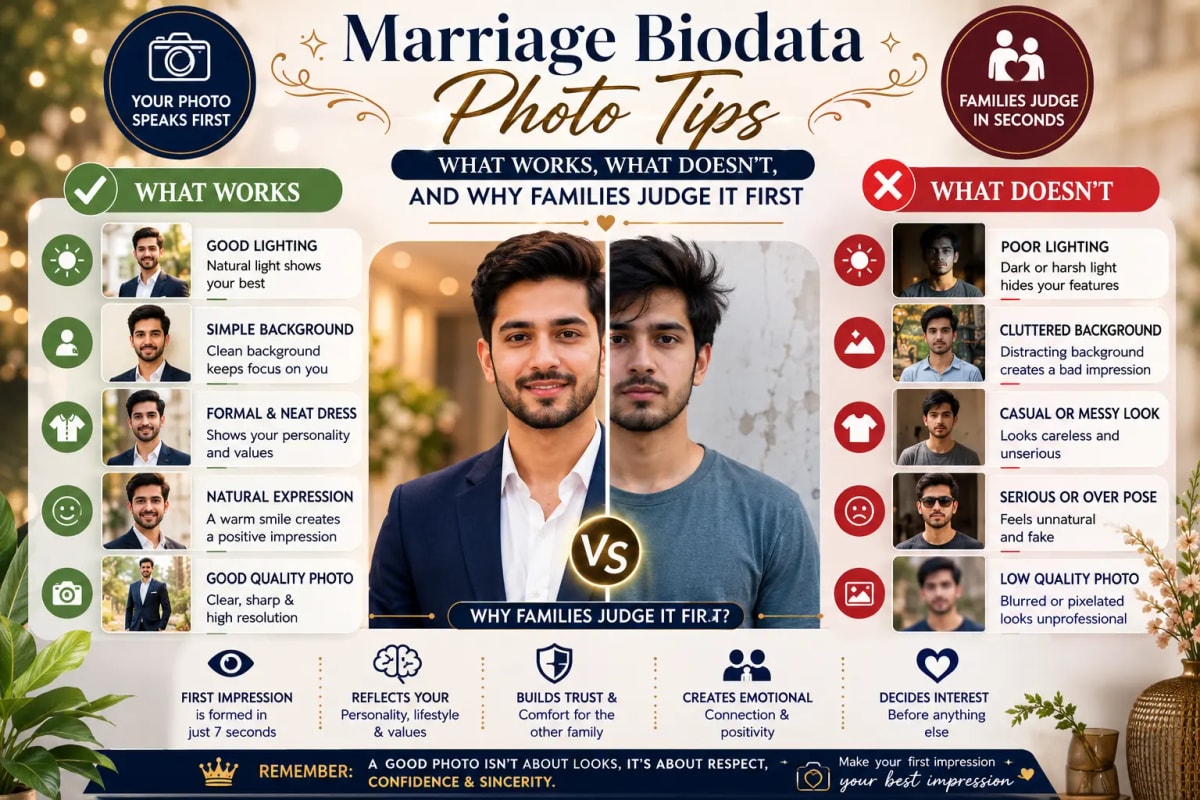
Why the photo gets looked at before anything else
This is not about photography. It is about how biodata review actually happens in most Indian homes — quickly, on a phone screen, while doing something else. Picture a mother sitting at the kitchen table on a Sunday morning. Three biodatas came in this week through a cousin's WhatsApp group. She opens the first one. What does she see first? The photo. Not the name. Not the qualification. The photo. It either creates a feeling of warmth and interest, or it does not. The rest of the biodata does not get the same chance if the photo lands wrong.
When a family is reviewing 15 or 20 biodatas in a week, the photo is the fastest filter. It is not about looks in the way people worry about — it is about whether the photo communicates something real and warm about the person. A good photo passes this filter. A bad photo does not. The family moves on before reading the name.
What makes a photo work — the actual specifics
Background: a plain wall in your home is perfect. White, cream, light grey, pale yellow — all fine. Off-white is actually better than pure white, which can wash out. A blurred background from portrait mode on a phone works well. What does not work: busy backgrounds with furniture competing for attention, outdoor backgrounds where the location competes with your face, dark backgrounds that make the image look like a passport photo. One of the most common mistakes: standing in front of a window with bright light behind you, so your face is in shadow. Turn around — face the window, do not stand with it behind you.
Light: natural light from a window or open door is genuinely the best for most people. You do not need a ring light or a studio. A cloudy afternoon near a large window is ideal — the light is soft, no harsh shadows. Direct midday sun creates shadows under eyes and nose. Early morning or late afternoon light is flattering. If you are taking the photo indoors at night, the overhead tube light in most Indian homes makes everyone look slightly yellow and tired. Move near a lamp instead, or wait for daytime.
Expression: this is where most biodata photos fail. The three common wrong expressions — the unsmiling formal look, which reads as unfriendly; the wide posed grin, which looks performative; the camera-aware tense face that happens when someone knows they are being photographed for a formal purpose. The right expression is a natural, warm, slight smile — the kind on your face when someone says something mildly funny. Take 20 to 30 photos in a short burst while someone is talking to you normally. One of them will have the right expression. Use that one.
Clothing: whatever you genuinely wear. A salwar kameez if that is your daily wear. A shirt and trousers if that is yours. You do not need to change into traditional clothes unless you wear them naturally. What does not work: gym clothes your mum keeps sending, clothes that are clearly for a wedding or party, anything with prominent logos or text.
Photo age: within six months. Families sometimes sense even a two-year difference before they can articulate why — it is something about the face that does not quite match how people look at their current age. If you have changed your hair, your weight, or your style significantly in the last year, use a recent photo. The awkward meeting where you look noticeably different from your biodata photo is exactly what everyone is trying to avoid.
Taking a good biodata photo on your phone — without a photographer
You do not need a studio. You need a good wall, a window with natural light, and someone to take the photo — a friend, a sibling, a parent. If you are genuinely alone, a phone tripod and a timer works. Most phones have a 3-second or 10-second timer in the camera.
- Step 1: Find your wall. Any plain wall in your home — a bedroom wall, the drawing room wall, even the outside wall of your building if the light is good.
- Step 2: Stand facing the light source. If there is a window, stand so the window light is falling on your face. This single adjustment makes the biggest difference between a good phone photo and a bad one.
- Step 3: Have the person photographing you hold the phone at slightly above your eye level — not from below (unflattering for nearly everyone), not pointing down at your head.
- Step 4: Take 25 to 30 photos in a row while having a normal conversation. Laugh at something real. Your expression will settle into something genuine in a few of them.
- Step 5: Choose the one where your expression is the most natural — not the thinnest or most glamorous, the one that looks most like you when you are at ease.
- Step 6: Crop to a portrait rectangle showing face and shoulders, with a small amount of space above your head. Not so tight that only your face is visible, not so loose that your body takes up half the frame.
On editing: adjust brightness and contrast slightly if needed. Remove a blemish if you want to — that is fine. Do not apply smoothing filters that make your skin look like it was painted on. Families notice this and find it off-putting. The Instagram-beauty-filter look reads as untrustworthy in a biodata context, even if people cannot explain why.
Photos that get biodatas set aside — real examples
The group photo crop: someone has used a photo from a family function, cropped out the people on either side, but you can still see a sliver of someone's shoulder or the edge of a dupatta. Immediately obvious it is a crop. Immediately reads as — this person does not have a single good photo of themselves, or they could not be bothered to take one.
The sunglasses photo: a common one from men, usually from a trip or an outdoor event. It looks cool. But the other family cannot see the person's eyes. Eyes are how people decide if someone has a warm or guarded face. The sunglasses make it impossible to read anything.
The formal ID photo: the standard passport-or-Aadhaar-style photo taken against a white background under fluorescent light. It looks like a document, not a person. The expression is usually frozen and the light is harsh. Using this does not say 'I take this seriously' — it says 'I did not put any effort into this.'
The heavily filtered selfie: the face looks smooth like CGI. Eyelashes enhanced. Skin toned. Families from traditional backgrounds do not always know why this looks wrong to them, but it does. It reads as someone hiding something, even when they are not.
The group wedding photo: the person looks great — good clothes, good mood. But they are standing in a wedding party with four other people and a decorated mandap behind them. The family receiving it has to figure out which one is the person in question. And the wedding clothes are too formal for a first introduction.
The gym selfie, the car selfie, the gym selfie again: these come almost exclusively from men. A selfie in the gym mirror, or leaning against a car, or in a bathroom. The light is wrong. The context is wrong. The expression is wrong. The family — especially the girl's mother — sees this and forms a very specific impression. It is not a good impression.
One photo or multiple?
One photo. Always one photo. A single good portrait at the top of the biodata, right next to or just below your name. Multiple photos feel like you are making a case for yourself, or compensating for one bad photo with another. The biodata is not Instagram. One clear, honest, recent photo is worth far more than three good-angled, strategically chosen ones. If a family wants to see more photos after initial interest, that is a natural part of the conversation that follows. The biodata photo is just a first introduction.
A note for parents choosing the photo for their child
You know your child better than anyone. But the photo you think makes them look best may not be the one that works best in a biodata context. Your son's gym photo or his photo with friends might look great to you. To a family reviewing a biodata, these contexts feel informal for an introduction. Your daughter's wedding function photo in full bridal-adjacent makeup might be the most beautiful photo you have of her — but it sets an expectation that can make the first meeting feel like a let-down when she shows up as herself on a normal day.
The photo that works best is one where your child looks like themselves on a good, normal day. Natural expression. Natural makeup or none. Clothes they actually wear. A warm, approachable face. Ask your child what photo they would want to use. The best biodata photos come from people who chose them themselves.
Frequently asked questions
What kind of photo should I use in a marriage biodata? Use a recent portrait taken in the last six months. Plain or light background, natural light, face and shoulders clearly visible. Expression should be natural and warm — not stiff, not over-posed. Wear whatever you normally wear. One good photo is better than multiple. Avoid: group photos, heavily filtered selfies, sunglasses, formal ID-style photos, and photos where the background competes with your face.
Can I use a phone photo in my marriage biodata? Yes. A phone photo taken in good light — near a window, outdoors on a cloudy day, or in any well-lit space — is completely fine and often better than a studio photo. Modern phone cameras produce high enough quality for biodata use. What matters is the light, the background, and your expression — not which device was used to take it. Take multiple photos in one session and choose the most natural one.
Does my marriage biodata photo need to be formal or traditional? No. You do not need to wear traditional clothes unless you genuinely wear them regularly. Smart casual — a kurta, a shirt, a salwar kameez — works fine. What families respond to is a warm, natural expression and a clear, uncluttered image. The photo should look like you on a normal day, not like you are dressed for a formal document photo or a festival.
Should I use a studio photo for my marriage biodata? A studio photo can work if the result looks natural. The problem with some studio photos is that the lighting is harsh, the background is fake-looking, and the person ends up with a stiff expression. If you use a studio, choose one that does natural-light portrait photography, not the standard passport-photo style. A good phone photo taken at home is usually more flattering and more natural-looking than a mediocre studio photo.
Ready to create your own biodata? Start with our free builder or browse premium templates.